
Celiac Disease in Children: Growth, Testing, and Diet Adherence

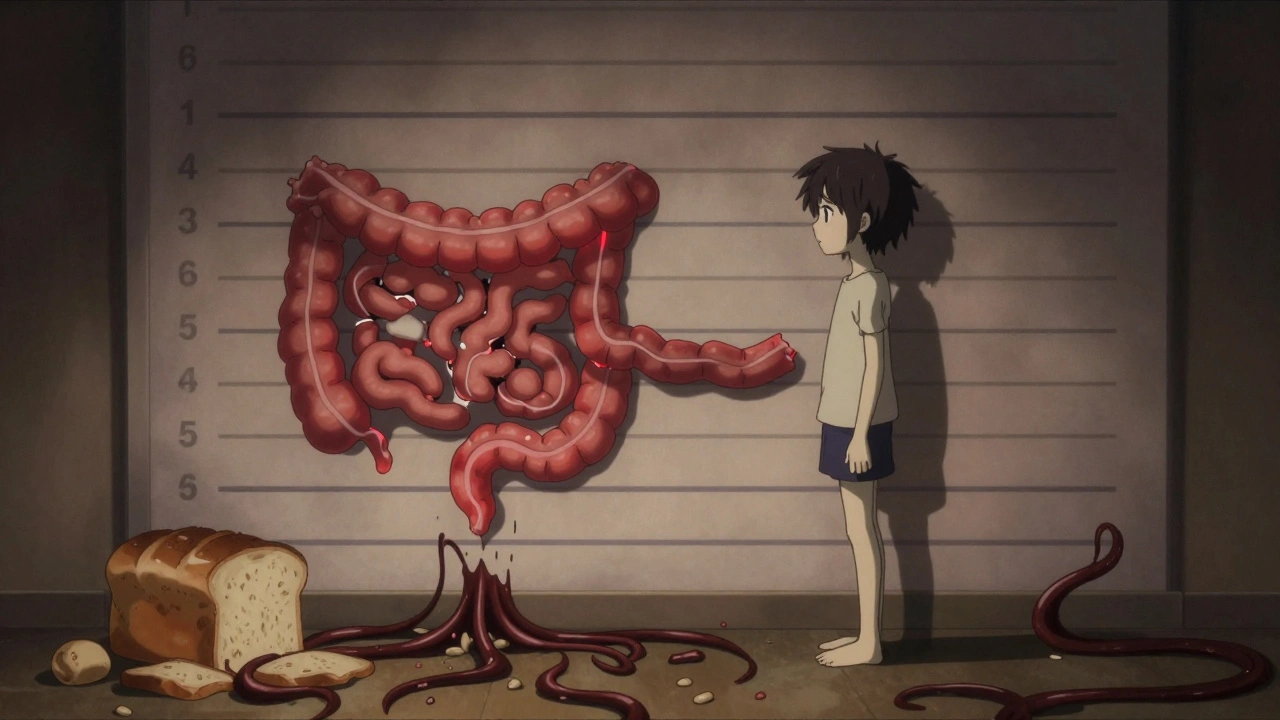
When a child isn’t growing like they should, parents often worry about nutrition, genetics, or just being a late bloomer. But what if the real issue is something hidden in their food? Celiac disease is one of the most common but underdiagnosed causes of growth problems in kids. It’s not just a stomach upset or food intolerance-it’s an autoimmune condition that quietly steals nutrients, stunts height, and drains energy. And the good news? When caught early and managed right, most children catch up completely.
Why Growth Gets Stuck
In celiac disease, the body attacks its own small intestine every time gluten is eaten. Gluten is a protein found in wheat, barley, and rye. In kids, this damage doesn’t just cause diarrhea or bloating-it blocks the tiny finger-like projections (villi) that absorb nutrients. Without those, the body can’t get enough protein, iron, calcium, or vitamins to build bones, muscles, and organs. That’s why many kids with undiagnosed celiac disease are shorter and thinner than their peers, even if they eat plenty. Studies show that up to 40% of children who come in for being unusually short end up being diagnosed with celiac disease. Their growth slows because their bodies are starving, even if they’re eating enough. The body tries to compensate by delaying bone age-meaning their skeleton matures slower than their real age. That’s actually a sign they still have time to grow, if the problem is fixed.How Doctors Test for It
Testing for celiac disease in children has gotten smarter and less invasive. The first step is a simple blood test for tissue transglutaminase antibodies (tTG-IgA). This test is accurate in 98% of cases when the child is still eating gluten. But it’s not enough on its own. Doctors also check total IgA levels because about 2-3% of kids with celiac are IgA deficient, which can make the test look falsely negative. If the blood test is strongly positive-especially if tTG-IgA is 10 times higher than normal-new guidelines from the European Society for Pediatric Gastroenterology allow diagnosis without a biopsy in many cases. This only works if the child also has symptoms, carries the HLA-DQ2 or DQ8 genes (which 95% of celiac patients have), and the blood results are clear-cut. For others, a small intestine biopsy during an endoscopy is still needed. The biopsy shows flattened villi, the hallmark of active celiac disease. Bone age X-rays of the hand and wrist are also commonly used. If a child’s bones are 1.5 to 2.5 years behind their actual age, that’s a strong clue their growth delay is due to something like celiac disease, not just genetics. And if the child has iron deficiency anemia or low vitamin D-both common in undiagnosed cases-that’s another red flag.What Happens After Diagnosis
The only treatment is a strict, lifelong gluten-free diet. No exceptions. Not even a crumb of bread, pasta, or cereal made with wheat. Gluten hides in unexpected places: soy sauce, malt flavoring, some medications, even play-dough. Families need to learn how to read labels and spot cross-contamination. A toaster used for regular bread can contaminate gluten-free toast. A shared fryer can turn fries into a hazard. Within the first 6 months of going gluten-free, most children start gaining weight. Their appetite returns, their stomachs stop aching, and their energy levels climb. But height doesn’t catch up as fast. It takes 12 to 24 months to see real growth acceleration. One study showed kids gained an extra 2 to 4 centimeters per year after starting the diet-enough to close the gap with their peers. By age 18, 85% of children who stick to the diet reach their expected adult height. The key is consistency. If a child eats gluten even once a month, their intestines stay damaged. Their antibodies stay high. Their growth stalls. That’s why doctors check tTG-IgA levels every 6 to 12 months. Normal levels mean they’re doing well. High levels mean something’s off-maybe a hidden gluten source, or accidental exposure.
Why Diet Adherence Is So Hard
Parents think, “We’ll just avoid bread and pasta.” But it’s not that simple. Gluten-free products cost 150% to 240% more than regular ones. A box of gluten-free cereal can be $8 instead of $3. A gluten-free pizza crust might cost $10. For many families, that’s a major financial burden. Social pressure is another big challenge. Kids hate being the only one who can’t eat the birthday cake, the school pizza, or the cafeteria hot dog. Teens especially struggle. One study found adolescents are 30% less likely to stick to the diet than younger kids. They want to fit in. They think, “One bite won’t hurt.” But it can set their growth back months. Cross-contamination is everywhere. A shared cutting board, a spoon used in regular peanut butter, or even flour dust in the air during baking can trigger a reaction. One parent reported her 7-year-old had abdominal pain every Friday-until they realized the school’s art teacher used wheat-based paste in crafts.What Works: Real Strategies for Families
Successful families don’t just go gluten-free-they build systems. They meet with a pediatric dietitian at least 3 to 5 times in the first year. They learn to identify hidden gluten sources. They get a 504 plan at school to ensure safe meals and clean prep areas. They join local celiac support groups, which improve adherence by 25%. Nutrition monitoring is non-negotiable. Kids need quarterly blood tests for iron, vitamin D, folate, and B12. Many start supplements right away. Iron deficiency anemia is common at diagnosis, and correcting it helps with energy and focus. Low vitamin D affects bone strength, so supplementation often continues for 18 months or longer. Some kids still don’t catch up fully. About 5-10% of children show no improvement in height despite perfect diet adherence. That’s when doctors check for other issues-like growth hormone deficiency or thyroid problems. But for the vast majority, the gluten-free diet is a miracle. One parent shared: “My daughter was in the 5th percentile for height at diagnosis. Two years later, she’s at the 50th. She’s taller than her older brother now.”
What’s Coming Next
Right now, there’s no cure. But research is moving fast. A drug called larazotide is in late-stage trials. It helps block gluten from leaking into the gut, reducing symptoms when accidental exposure happens. It’s not a replacement for the diet, but it could be a safety net. Immunotherapy trials, like Nexvax2, were halted because they didn’t work. But scientists are still exploring other ways to retrain the immune system. For now, the gluten-free diet remains the gold standard.What Parents Should Remember
Celiac disease isn’t a phase. It’s not a trend. It’s a lifelong condition that can derail a child’s growth if missed. But it’s also one of the few chronic diseases that can be fully reversed with diet alone. The earlier it’s diagnosed, the better the outcome. Kids diagnosed before age 5 have a 98% chance of reaching their full adult height. After age 10, that drops to 85%. If your child is short, tired, pale, or has stomach issues-and they’re not improving with better nutrition-ask for a celiac test. It’s simple. It’s safe. And it could change their life.You might like
Dematteo Lasonya
My niece was diagnosed at 6 after years of being in the 3rd percentile. Went gluten-free and within 8 months she started shooting up. Now she’s taller than her brother. It’s wild how something so simple can change everything.
Just wish more doctors thought to test before jumping to ‘late bloomer’.
Rudy Van den Boogaert
I’m a pediatric nurse and I’ve seen this too many times. Kids come in looking pale, tired, with bloated bellies - parents think it’s ‘picky eating’ or ‘stress’. Then the blood test comes back positive and it’s like a light switch flips. The energy return is insane. One kid who couldn’t climb stairs now runs track. Gluten-free isn’t a trend - it’s medicine.
Gillian Watson
My cousin in London got diagnosed after her daughter stopped growing at 4. The cost of gluten-free stuff here is ridiculous. A single loaf of GF bread costs £5.50. We’re lucky we can afford it but so many families can’t. Shouldn’t this be covered like insulin?
Jordan Wall
Oh wow, another ‘gluten is the devil’ post 🙄
Let me guess - you also think vaccines cause autism and fluoride is a government plot? Celiac’s real, sure, but 90% of people who go GF are just chasing placebo vibes. Also, ‘villi’? That’s not a word you use in casual convo, Karen. 🤓
Gareth Storer
So let me get this straight - you’re telling me a kid can be ‘malnourished’ while eating a whole pizza? Sounds like lazy parenting. If your kid’s not growing, maybe they’re just eating junk and you’re too busy scrolling to notice.
Blame gluten. Always blame gluten.
Pavan Kankala
Gluten? More like corporate control. Big Agri and the FDA are pushing this ‘diagnosis’ so they can sell you overpriced GF crap. You think this is medicine? Nah. It’s a multi-billion dollar scam. They want you dependent. They want you afraid. Look at the stats - gluten-free market hit $8.3B in 2023. Coincidence? I think not. 🌍👁️
Martyn Stuart
Important note: Always test for total IgA before relying on tTG-IgA alone - IgA deficiency is underdiagnosed and leads to false negatives. Also, cross-contamination isn’t just about toasters - it’s shared butter knives, condiment jars, even hand soap residue. Many parents don’t realize this. A dietitian visit isn’t optional - it’s critical. And yes, supplements matter: iron, B12, D, zinc - all need monitoring. Don’t assume ‘gluten-free’ = ‘nutrient-rich’.
Jessica Baydowicz
My son was diagnosed at 7 - he was a ghost. No energy, no joy. After 3 months GF? He started laughing again. Like, actual, loud, snort-laughing. Now he’s into soccer, baking his own GF cupcakes, and begging for more veggies. It’s not just health - it’s happiness. You guys are doing amazing. Keep going. 💪✨
Shofner Lehto
One thing no one talks about: the mental load on moms. Reading every label. Calling manufacturers. Packing lunches while everyone else eats cafeteria food. It’s exhausting. And when your kid gets teased? That’s the real battle. Support groups aren’t just helpful - they’re survival tools. If you’re a parent doing this, you’re a warrior.
Yasmine Hajar
My daughter was diagnosed at 10. We were told she’d only gain 1-2 inches. She’s now 5’9”. Taller than her dad. The school didn’t want to accommodate her - we had to fight for a 504 plan. Now they have a GF kitchen station. I’m not mad - I’m just proud. If your kid’s not growing - test. Don’t wait. Don’t assume. This isn’t hype. It’s science. And it works.
Karl Barrett
There’s a deeper philosophical layer here - the body as a self-regulating system that’s been hijacked by industrialized food. Gluten isn’t the villain - it’s the trigger. The real issue is how our modern diet has destabilized immune tolerance. Celiac is a canary in the coal mine for systemic dysbiosis. We’re not just treating a disease - we’re correcting a cultural rupture between human biology and the food system. The gluten-free diet is a return to ancestral alignment - not a restriction, but a reclamation.
Jake Deeds
Wow. Just… wow. I’ve been waiting for someone to say this out loud. People think celiac is just ‘a diet’ - but it’s a sacred covenant with your child’s future. And those who ignore it? They’re not just negligent - they’re playing Russian roulette with their kid’s bones. I’ve seen kids who never recovered because their parents ‘let them have one slice’. One slice. One. Single. Slice. And now they’re 18 and 5’2”. You think that’s fair? No. It’s not. It’s betrayal.