
Common Prescription Label Misunderstandings and How to Avoid Them

Why Your Prescription Label Might Be Leading You Astray
You pick up your medicine, scan the label, and think you’ve got it figured out. But what if you’re wrong? A 2023 study found that nearly half of all adults misread at least one instruction on their prescription label. That’s not just confusing-it’s dangerous. People end up in the ER because they took too much, too little, or at the wrong time. And it’s not because they’re careless. It’s because the labels themselves are poorly designed.
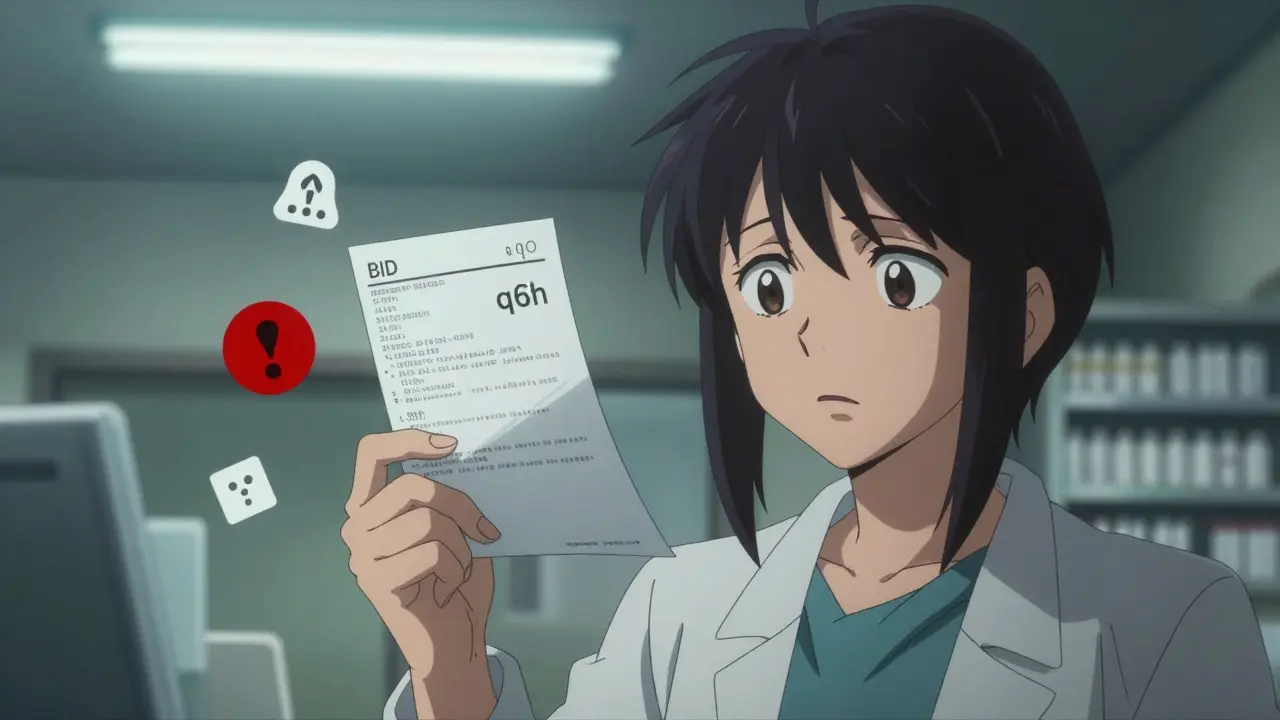
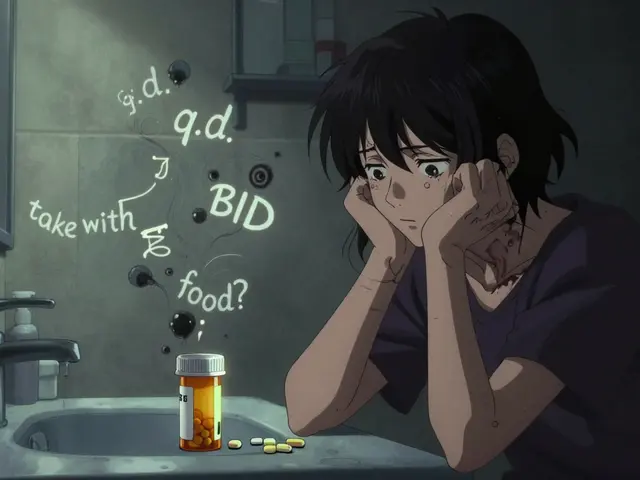
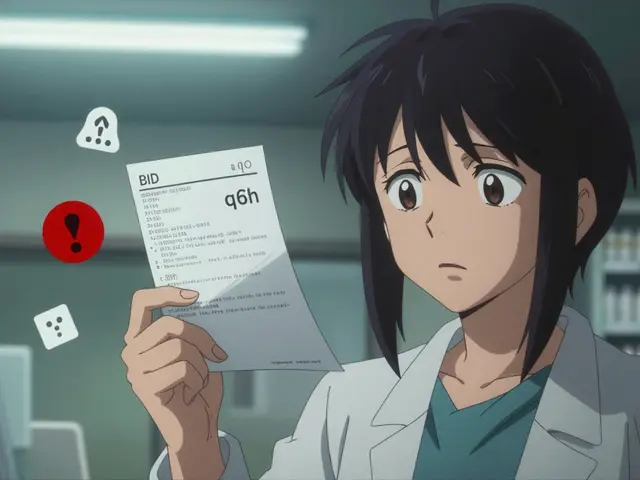
Labels often use medical jargon like "BID," "q6h," or "PO." Even simple phrases like "take with food" can be misunderstood. One patient thought it meant to eat instead of taking the pill with a meal. Another took their antibiotic four times a day because they divided 24 by 6 and assumed "q6h" meant four doses. They ended up with stomach bleeding. These aren’t rare mistakes. They’re predictable.
What’s Actually on the Label (And What’s Missing)
Most prescription labels follow outdated templates. They’re cluttered, small, and full of abbreviations. The drug name might be in 10-point font. The dosage instructions? Written in Latin. The warning about alcohol? Hidden under a tiny sticker that might not even be there.
Here’s what’s often missing:
- Clear timing: "Take twice daily" doesn’t tell you when. Is it morning and night? Or 8 a.m. and 8 p.m.?
- Food instructions: "Take with food" sounds simple, but many think it means to take the pill only if they’ve eaten something.
- Duration: "Take for 10 days"-but what if you feel better after 3? Do you stop? Do you keep going?
- Language: Only 12% of U.S. pharmacies offer labels in Spanish, even though over 40 million people speak it.
And here’s what’s often wrong:
- Reading level: 27% of label instructions are written at a high school level or higher. That’s too complex for many adults.
- Icons: A picture of a fork next to "take with food" is meant to help-but 68% of people misinterpret it.
- Font size: Labels range from 10 to 14 points. That’s the difference between readable and unreadable for someone with poor vision.
How the Best Labels Work (And Where They’re Used)
The good news? There’s a better way. The US Pharmacopeia (USP) created clear labeling standards in 2007. These aren’t suggestions-they’re science-backed. Labels that follow these rules reduce errors by more than half.
Here’s what a good label looks like:
- Drug name: Big, bold, 12-point font or larger.
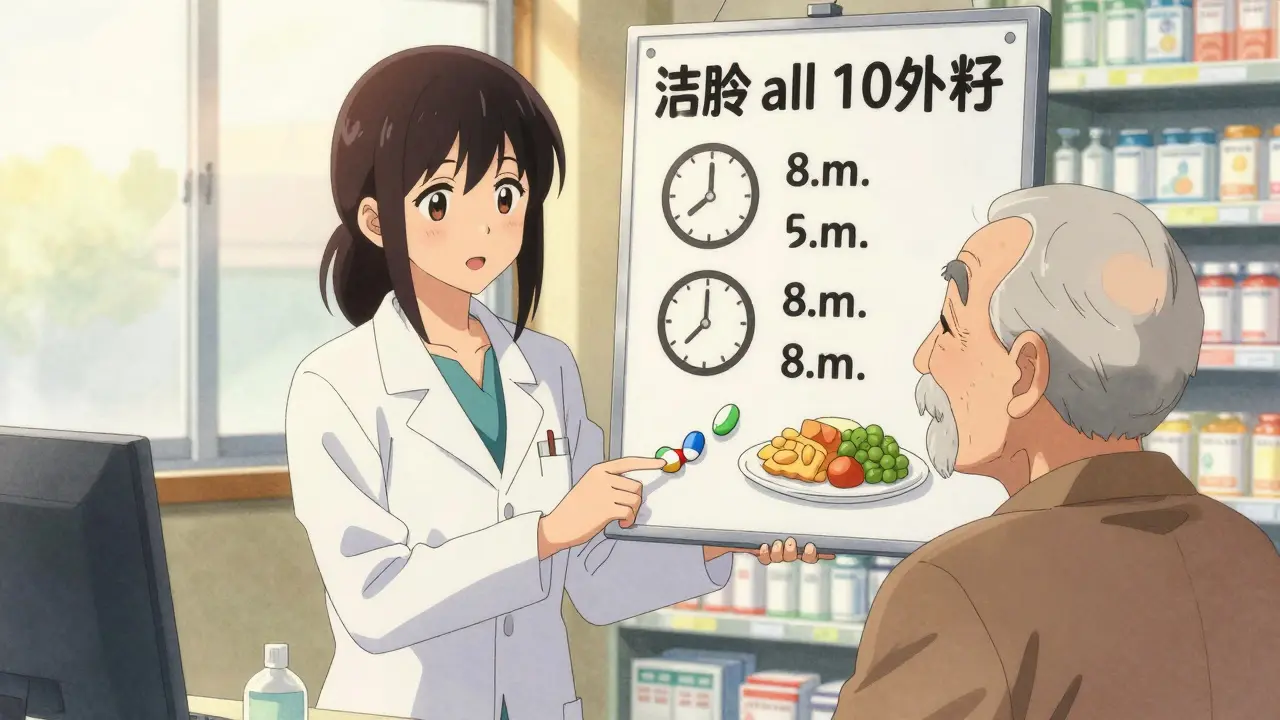
- Dosage: "Take 1 tablet by mouth two times each day-once in the morning and once in the evening." No abbreviations. No Latin.
- Timing: Clock icons showing 8 a.m. and 8 p.m.
- Food: A picture of a pill next to a plate of food, not just a fork.
- Duration: "Finish all 10 pills, even if you feel better."
- Warning: Simple text like "Do not drink alcohol while taking this medicine," not a tiny symbol.
Pharmacies like CVS, Walgreens, and Walmart have adopted these standards across most of their stores. But independent pharmacies? Many still use the old, confusing templates. If you’re getting your meds from a small local pharmacy, don’t assume the label is clear.
What Patients Can Do Right Now
You don’t have to wait for the system to fix itself. Here’s what you can do the moment you get your prescription:
- Ask the pharmacist: "Can you explain this to me like I’m 12?" Don’t be shy. Pharmacists are trained to help.
- Use the "Teach-Back" method: After they explain, say back what you understood. "So, I take one pill at 8 a.m. and another at 8 p.m. for 10 days?" If they correct you, you just avoided a mistake.
- Request a large-print label. Almost all major chains offer this for free.
- Ask for a visual schedule. Some pharmacies now give you a small card with icons showing when to take each dose.
- Take a photo of the label with your phone. Zoom in. Read it slowly. If anything feels off, call the pharmacy back.
And if you’re helping an older parent or someone with memory issues? Write the instructions on a sticky note. Put it on the fridge. Or set phone alarms labeled "Take Blood Pressure Pill" instead of just "1 pill."
The Hidden Problem: Language and Literacy
It’s not just about reading ability. It’s about language. Spanish-speaking patients are 3.2 times more likely to misunderstand labels-even when they’re translated. Why? Because translations are often done by software or non-medical staff. "Take on an empty stomach" becomes "Tome en un estómago vacío," which doesn’t mean anything to someone who’s never heard the phrase "empty stomach."
Even college-educated people get it wrong. One study found 23% of patients with a bachelor’s degree misread their label. Why? Because they assume they know what "BID" means. It doesn’t. It means "twice a day," but most people don’t know that.
Health literacy isn’t about education. It’s about clarity. A label that works for someone with a PhD should work for someone who didn’t finish high school. That’s the goal.
What’s Changing-and What’s Coming
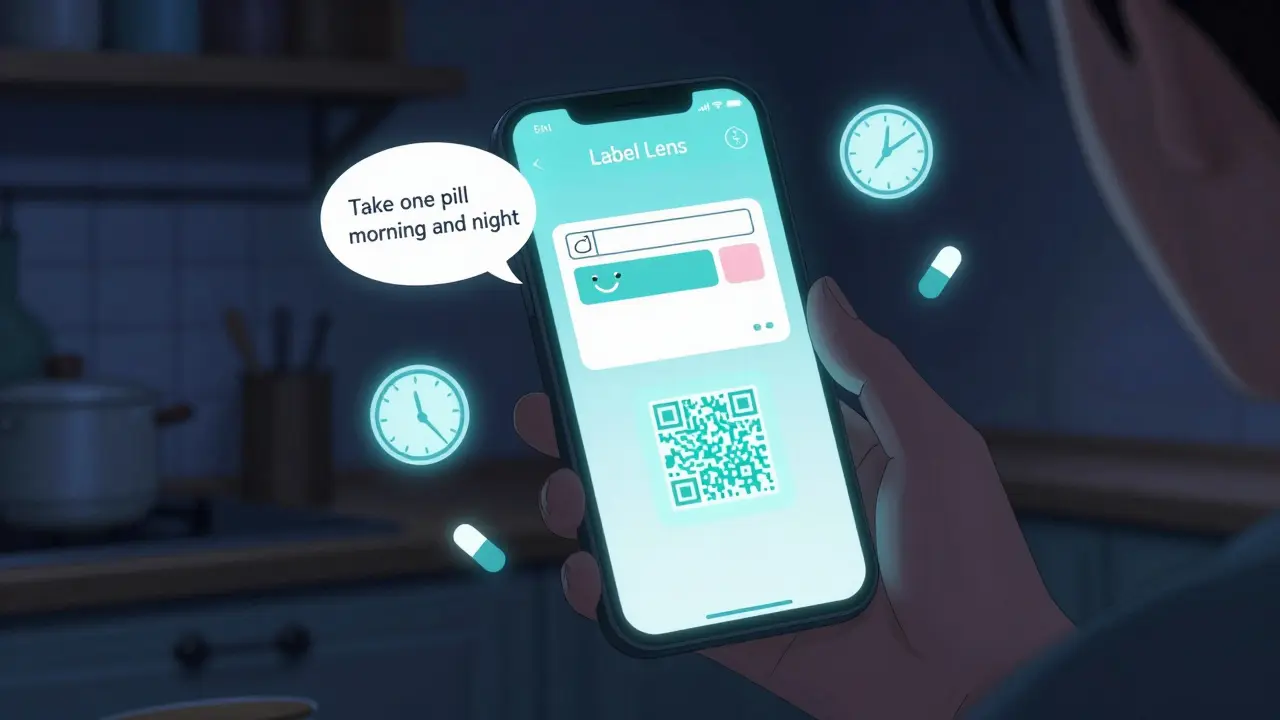
Things are slowly improving. In 2025, new rules will require QR codes on prescription labels. Scan it, and your phone will show a video of someone taking the pill with clear voice instructions. Pilot programs at Mayo Clinic cut errors by 62%.
Amazon Pharmacy now offers voice-enabled labels. Say, "Hey, how do I take this?" and it reads the instructions aloud in plain English. GoodRx’s "Label Lens" app uses AI to scan your label and rewrite it in simple terms. It’s 89% accurate.
But the biggest change? Federal pressure. The FDA is moving toward making clear labeling mandatory by 2025. Right now, only 17 states require it. That’s changing. By 2030, experts estimate these changes could prevent over 127,000 hospitalizations each year.
Final Advice: Never Guess
If your label doesn’t make sense, it’s not your fault. It’s the system’s. But you’re the one who has to live with the consequences. Don’t guess. Don’t assume. Don’t rely on memory.
Call the pharmacy. Ask for help. Request a clearer version. Use your phone to record the pharmacist explaining it. Keep a written schedule. Use pill organizers labeled with pictures.
Medication errors are preventable. But only if you speak up. Only if you ask. Only if you refuse to accept a label that doesn’t work for you.
You might like
Demetria Morris
I can't believe we're still letting pharmacies get away with this. I had a relative die because of a misread label. No one held anyone accountable. Just another corpse in the system's wake.
Geri Rogers
YESSSS this is SO IMPORTANT 💪❤️ I work in a pharmacy and I literally beg patients to ask questions - but so many just nod and leave. Please, if you’re unsure, ASK. We’re not here to judge, we’re here to keep you alive. And if your pharmacy won’t give you a visual schedule? Ask for a manager. Seriously. 🙏
Samuel Bradway
My grandma used to take her blood pressure meds at 3 a.m. because she thought 'twice daily' meant every 12 hours from when she woke up. She didn’t even know what 'BID' meant. We ended up making a color-coded chart with stickers. It saved her life. Just talk to your pharmacist - they’re way more helpful than you think.
Caleb Sutton
QR codes on prescriptions? That’s just Step 1 of the Big Pharma surveillance program. They’re tracking when you take your meds, then selling that data to insurers so they can raise your premiums. And don’t get me started on Amazon Pharmacy - they’re already logging your health data to target you with ads. This isn’t safety. It’s control.
pradnya paramita
From a pharmacovigilance standpoint, the core issue lies in the cognitive load imposed by suboptimal label design. The use of Latin abbreviations like 'q.d.' and 'b.i.d.' represents a vestigial artifact of pre-digital medical communication, which fails to align with contemporary health literacy benchmarks. The absence of standardized iconography exacerbates perceptual ambiguity, particularly among non-native English speakers and geriatric populations. Implementation of USP-compliant labeling protocols demonstrably reduces medication-related adverse events by 52–68% in controlled trials.
Jamillah Rodriguez
Ugh I’m so tired of this. Like yeah labels are confusing but can we just… not make this a whole thing? I just want to take my pills without a lecture. 😒
Susheel Sharma
The real tragedy isn't the labels-it's the systemic rot that allows this to persist. We've got AI-powered apps and voice assistants, yet we're still handing out tiny, cryptic slips of paper like it's 1987. And let's be real: the FDA’s 'mandatory by 2025' is just a PR stunt. Big Pharma lobbyists have already buried the real reforms in subcommittee hearings. This isn't negligence-it's intentional obfuscation.
Janice Williams
How is it possible that in the year 2024, a patient must beg for basic clarity regarding their own medication? This is not a failure of literacy-it is a moral failure of the healthcare industrial complex. Those who design these labels are not merely incompetent; they are complicit in harm. And yet, they receive salaries, bonuses, and pensions. The system is not broken. It is working exactly as intended.
Rachel Kipps
im not sure if i read this right but i think the part about spanish translations being done by software is true? my aunt got a label that said 'take with empty stomach' and she was so confused because she thought it meant don't eat anything at all. she ended up fainting. i think the pharmacy should be fined.
caroline hernandez
As a clinical pharmacist, I’ve trained over 200 patients using the teach-back method. It’s not just about repeating instructions-it’s about building trust. When someone says, 'So I take this after breakfast and not before?' and you say, 'Exactly!'-that’s when the fear melts. Don’t just hand out a label. Hand out safety. And if you’re a caregiver? Write it on the fridge. Make it visible. Make it sacred.
Jhoantan Moreira
This is such an important topic ❤️ I’ve seen friends and family struggle with this, and it breaks my heart. The fact that we can fix this with simple changes-bigger fonts, clear timing, voice help-makes it even sadder that we haven’t already. Let’s push for change, but also be kind to pharmacists. They’re doing their best in a broken system. 🙌
Joseph Cooksey
Let’s be honest-this isn’t about labels. It’s about the slow, deliberate erosion of personal responsibility in healthcare. People don’t read because they’ve been conditioned to outsource every decision. Why bother understanding 'q6h' when you can just scan a QR code? Why memorize timing when your phone will remind you? We’ve turned medicine into a tech support ticket. And now we’re surprised when the system fails? The real problem isn’t the font size-it’s the mindset. We’ve surrendered our agency to convenience, and now we’re blaming the pharmacy for the consequences. Wake up.
Sherman Lee
QR codes? Voice assistants? AI label readers? All distractions. The real agenda is biometric tracking. Every time you scan that code, your biometrics get uploaded to a federal database. They’re building a national medication compliance registry. You think they want to help you? They want to control you. The FDA doesn’t care if you live or die-they care if you’re compliant. And if you skip a dose? That’s a red flag. That’s a target. This isn’t safety. It’s social credit for your pills.