How to Coordinate Mail-Order and Local Pharmacy to Save Money: A 2026 Guide

Did you know that mail-order pharmacy is a service that delivers 90-day supplies of maintenance medications directly to your home, often at a lower cost than retail fills could be costing you more money than staying with your corner drugstore? It sounds counterintuitive. Insurance companies push mail-order services hard because they save the insurer administrative costs-not necessarily you. In fact, recent data shows that for certain specialty medications, commercial plans charge higher copays for mail-order than for local retail fills.
But here’s the good news: you don’t have to choose just one. The real secret to slashing your medication bills isn’t picking a winner between mail-order and local pharmacies. It’s coordinating them. By strategically splitting your prescriptions based on type, urgency, and insurance tiers, most patients can save hundreds of dollars annually without sacrificing convenience or care quality.
Why Your Insurance Pushes Mail-Order (And Why You Should Be Skeptical)
To understand how to save money, you first need to understand the game being played. Insurance providers and Pharmacy Benefit Managers (PBMs) like Express Scripts and Caremark have heavily incentivized mail-order use since the early 2000s. They do this by offering lower copays for 90-day supplies sent via mail compared to 30-day fills at a local counter.
For example, a typical Medicare Part D plan might charge you $45 for a 30-day supply of a Tier 3 brand-name medication at a retail pharmacy. That same medication, ordered as a 90-day supply through mail-order, might cost $115 total. On paper, that looks like a win-you’re paying less per day. However, Dr. Karen Ignagni, former CEO of America's Health Insurance Plans, notes that insurers promote this primarily because it reduces their administrative overhead by 15-20% per transaction. They aren't doing it purely out of charity.
The trap? Many people assume mail-order is always cheaper. A 2022 RAND Corporation study found that 28% of commercial insurance plans actually charge higher copays for mail-order than local retail for specific specialty drugs. If you blindly switch everything to mail-order without checking your specific formulary, you might end up paying more while waiting two weeks for delivery.
The Three-Bucket Strategy: Classifying Your Medications
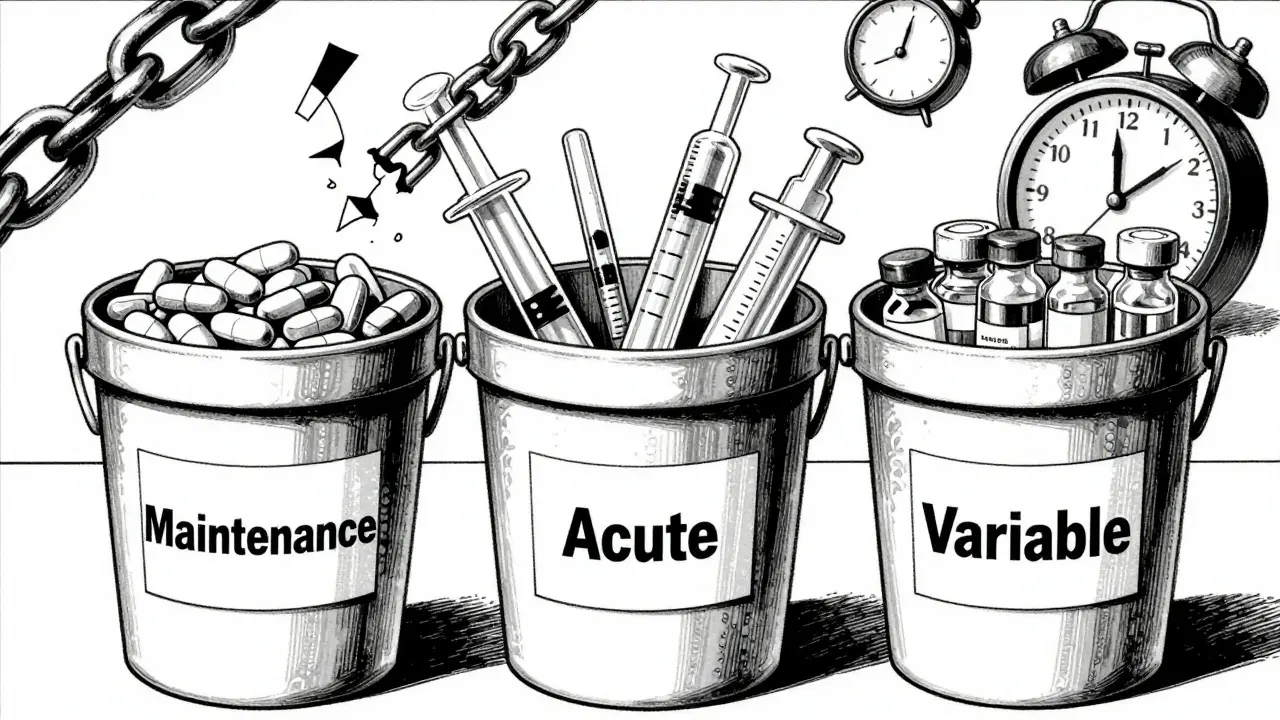
The cornerstone of effective coordination is categorizing your medications into three distinct buckets. This approach, recommended by experts like Dr. John Santa from Consumer Reports, ensures you get the lowest price and the best service for each specific need.
- Maintenance Medications: These are drugs you take daily for chronic conditions, such as hypertension, diabetes, or high cholesterol. You likely won’t stop taking these for years. Examples include amlodipine, metformin, or statins like atorvastatin. These are ideal candidates for mail-order pharmacy services because the dosage is stable, and you can plan ahead.
- Acute or Short-Term Medications: These include antibiotics, painkillers for injuries, or anti-nausea drugs. You need them immediately, and you only need them for a few days. Never use mail-order for these. The 7-14 day shipping delay makes them useless when you’re sick.
- Variable-Dose or New Prescriptions: These are new treatments where your doctor might adjust the dose in the first few months. Antidepressants, blood pressure meds during initial titration, or thyroid hormones fall here. Keeping these at a local retail pharmacy allows for quick adjustments and face-to-face pharmacist consultations if side effects occur.
By separating your meds this way, you avoid the common nightmare scenario where a doctor changes your dose, but the mail-order pharmacy keeps sending the old strength because their system hasn’t synced with your electronic health record (EHR). One user reported wasting $65 on unused medications due to this exact lag.
Comparing Costs: Mail-Order vs. Local Retail
Let’s look at the numbers. How much can you actually save? According to a 2007 Journal of Managed Care Pharmacy study, overall member costs were 29% lower for mail-order than community pharmacy across therapeutic categories. More recently, Kaiser Permanente Northern California documented that patients using mail-order for chronic conditions saved an average of $18.75 per prescription.
| Feature | Mail-Order Pharmacy | Local Retail Pharmacy |
|---|---|---|
| Typical Supply | 90-day | 30-day (often offers 90-day) |
| Average Generic Copay | $12.50 (90-day) | $15.00 (30-day) / $10-$25 (discount programs) |
| Delivery Time | 7-14 business days | Same-day or next-day |
| Consultation Access | Phone-only | Face-to-face (78% patient preference) |
| Best For | Maintenance, stable doses | Acute needs, new prescriptions, temperature-sensitive drugs |
Note that many local pharmacies now match mail-order pricing for 90-day fills. Programs like CVS’s $4/$10/$25 generic tier or Walmart’s $10 generic program allow you to buy a 90-day supply locally without the wait. Always call your local pharmacy and ask: "Do you offer a 90-day fill option, and does my insurance cover it at the same rate as mail-order?" You might be surprised.
Special Considerations: Temperature-Sensitive and Specialty Drugs
Not all medications play nice with the postal service. If you take biologics, insulin, or certain injectables, you need to be cautious. The FDA warns that these medications can lose potency if exposed to extreme temperatures during shipping. While mail-order companies use insulated packaging, the risk remains higher than picking up the box yourself from a climate-controlled local pharmacy.
Additionally, specialty medications-often used for complex conditions like rheumatoid arthritis or multiple sclerosis-have unique handling requirements. As mentioned earlier, some insurance plans penalize mail-order for these high-cost drugs. Always verify with your specialist’s office or the pharmacy benefit manager before switching a specialty med to mail-order.

Step-by-Step: How to Set Up Your Coordination System
Implementing this strategy takes about 45-60 minutes initially, then minimal effort. Here is how to do it effectively:
- Audit Your Meds: List every medication you take. Categorize them into the three buckets defined above.
- Check Your Formulary: Log into your insurance portal or call member services. Ask specifically for the copay difference between a 30-day retail fill and a 90-day mail-order fill for each maintenance medication. Also ask if your local pharmacy matches the mail-order price for 90-day fills.
- Transfer Maintenance Meds: Move your long-term, stable medications to the mail-order service or the local pharmacy that offers the best 90-day price. Ensure your doctor’s office sends prescriptions electronically to both locations to avoid sync issues.
- Set Calendar Reminders: Mail-order takes 7-14 days. Set a reminder on your phone for 10-14 days before you run out. This prevents gaps in treatment. One successful user noted, "I set calendar reminders 10 days before running out to order refills-this avoids the 7-10 day shipping delay."”
- Establish a Local Relationship: Pick one local pharmacy for your acute and variable-dose meds. Build a relationship with a specific pharmacist there. They can help spot interactions and provide immediate advice.
Pitfalls to Avoid
Even with a solid plan, things can go wrong. Here are the most common traps:
- Ignoring Plan Changes: Insurance formularies change annually. 41% of users report unexpected plan changes affecting their costs. Review your benefits statement every January or when you receive your annual renewal notice.
- Assuming All Generics Are Equal: While bioequivalent, some patients react differently to generic manufacturers. If you switch from a local generic to a mail-order generic and feel worse, contact your doctor immediately.
- Forgetting About State Licensing: Mail-order pharmacies must be licensed in your state. If you move or travel frequently, check if your preferred mail-order service operates in your current location. 28 states require separate licenses for out-of-state operations.
By treating your pharmacy choices as a portfolio rather than a single decision, you gain control over your healthcare spending. You get the convenience of home delivery for routine meds, the immediacy of local care for urgent needs, and the financial clarity of comparing true out-of-pocket costs. Don’t let the default setting dictate your budget-take the time to coordinate, and watch your savings grow.
Is mail-order pharmacy always cheaper than local pharmacy?
No. While mail-order often has lower copays for 90-day supplies of maintenance medications, it is not always cheaper. Some insurance plans charge higher copays for mail-order for specialty drugs. Additionally, many local pharmacies offer discount programs (like $4/$10/$25 generics) or match mail-order pricing for 90-day fills. Always compare the actual out-of-pocket cost for your specific medication and plan.
How long does mail-order pharmacy delivery take?
Most mail-order pharmacies require 7-14 business days for delivery. This lead time makes them unsuitable for acute medications needed immediately. To avoid running out, you should set refill reminders 10-14 days before your current supply ends.
Can I get a 90-day supply at a local pharmacy?
Yes. Many local retail pharmacies offer 90-day fills for maintenance medications. In some cases, the price may be identical to mail-order, especially if your insurance plan has integrated networks. Ask your local pharmacist if they can dispense a 90-day supply and check the associated copay.
What medications should NOT be sent via mail-order?
Avoid mail-order for acute medications (antibiotics, painkillers), new prescriptions requiring dose adjustments, and temperature-sensitive drugs like insulin or biologics. These require immediate access, frequent monitoring, or controlled storage conditions that local pharmacies handle better.
How do I prevent medication errors when using two pharmacies?
Ensure your doctor’s office sends prescriptions electronically to both pharmacies. Keep a master list of all your medications and share it with both pharmacists. Use a medication calendar to track refill dates and never duplicate orders. Regularly review your medication regimen with a pharmacist to catch any potential interactions or syncing issues.
You might like