
Blue Light and Eye Health: Screen Filters and Habits That Actually Work

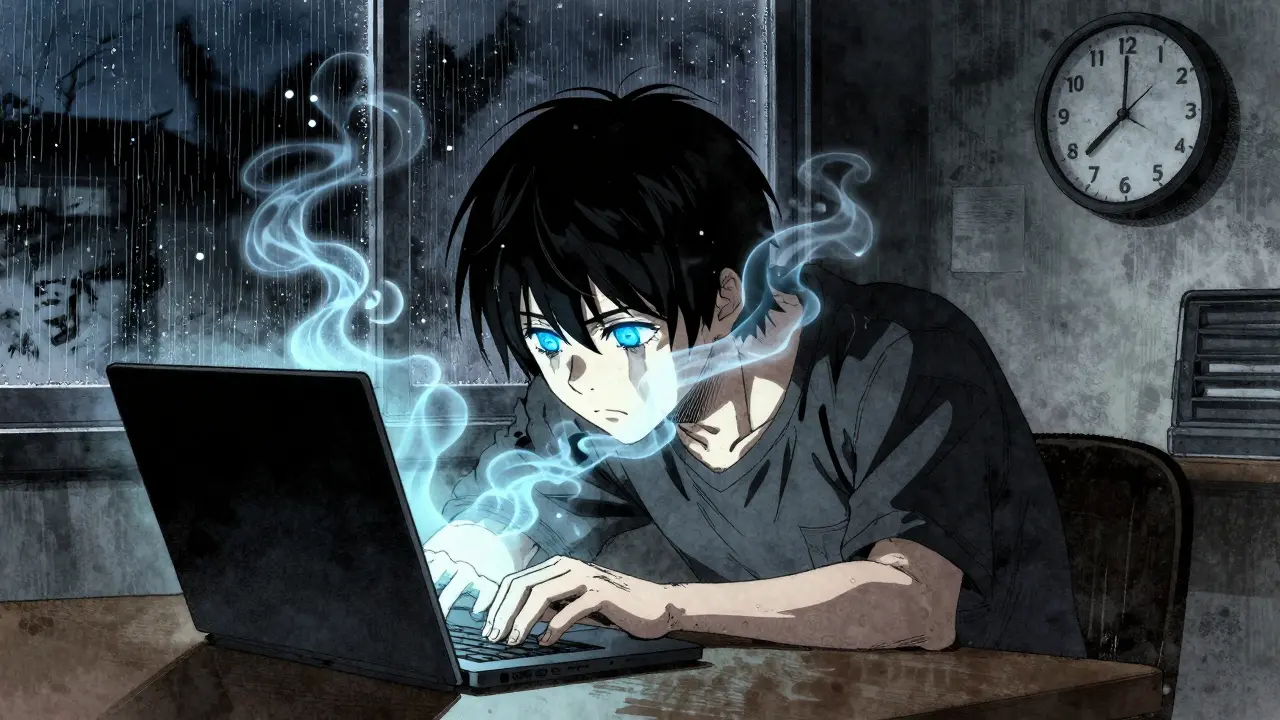
When you’re staring at a screen for hours-whether it’s your laptop, phone, or tablet-you might notice your eyes feel dry, tired, or achy. Maybe you get headaches after work. Or you can’t fall asleep even when you’re exhausted. It’s not just in your head. This is digital eye strain, and blue light from screens plays a big part in it.
What Exactly Is Blue Light?
Blue light isn’t just from screens. The sun emits it too. But the kind that matters for eye health is the high-energy visible (HEV) light between 415 and 455 nanometers. That’s the short-wavelength, high-energy blue light that penetrates deep into your eye, past the cornea and lens, all the way to the retina. Studies show this specific range can trigger oxidative stress in eye cells, leading to inflammation and even cell death over time. One 2018 NIH study found that 24 hours of exposure to this light reduced corneal cell viability by nearly 40% in lab conditions. But here’s the twist: your eyes aren’t getting damaged from scrolling through Instagram. The real issue isn’t permanent damage-it’s daily strain and sleep disruption. The American Academy of Ophthalmology says there’s no proof blue light from screens causes macular degeneration or cataracts. But they also admit it can make your eyes feel awful. And that’s enough reason to pay attention.Why Your Eyes Feel So Bad After Screens
It’s not just blue light. It’s how you use screens. When you stare at a display, you blink less-about 66% less, according to research. Less blinking means your eyes dry out faster. Your eyes also have to work harder to focus on close-up text, especially if the screen is too close or too bright. That’s called accommodative stress. And because blue light scatters more than other colors, your eyes struggle to focus it cleanly on the retina. This creates blur and glare, forcing your muscles to overwork. Add to that: your brain thinks it’s daytime when the screen glows bright and cool. That’s because blue light suppresses melatonin, the sleep hormone. Harvard studies show blue light at night delays melatonin release by over an hour-much more than warm-toned light. So even if you fall asleep, your sleep quality suffers. You wake up tired, even after eight hours.Screen Filters: Do They Help?
There are two main types of screen filters: software and hardware. Software filters like Night Shift (iOS), Night Light (Windows), or f.lux adjust your screen’s color temperature. They don’t block blue light-they make it warmer. At max settings, they reduce blue light by about 10-20%. That’s helpful for sleep, but not enough to fix eye strain. A 2021 study found these tools barely touch the most harmful 415-455 nm range. They’re good for bedtime, but not for all-day protection. Hardware filters are physical screen overlays or built-in display tech. OLED screens from newer phones and tablets already reduce blue light emission by 30-40% without software. Some lenses, like Essilor’s Eyezen, claim to block 20% of blue light. But Consumer Reports tested them in 2023 and found they only blocked 12%. That’s a big gap between marketing and reality. Blue light-blocking glasses? They vary wildly. Clear lenses with a faint coating block 10-25%. Amber-tinted ones block 65-100%. But here’s the catch: the amber ones make everything look yellow. For graphic designers, photographers, or anyone who works with color, that’s a dealbreaker. A 2022 University of Manchester study showed they reduce visual acuity by over 8% in color-sensitive tasks. If you’re not doing color work, they might help. But they’re not magic.
The Real Solution: Habits, Not Gadgets
The most effective way to protect your eyes isn’t a filter-it’s a habit. And it’s free. The 20-20-20 rule is simple: every 20 minutes, look at something 20 feet away for 20 seconds. It sounds silly, but a 2021 study in Optometry and Vision Science showed it reduces eye strain by over 53%. Why? Because it gives your focusing muscles a break. It resets your blink rate. It lets your eyes relax. Pair that with these three habits:- Adjust your brightness. Your screen shouldn’t be brighter than your surroundings. If your room is lit at 400 lux, your screen should be around 300-500 lux. Too bright? Your pupils constrict. Too dim? You squint. Both cause fatigue.
- Use night mode two hours before bed. A University of Toronto study found this boosts melatonin by 58%. Don’t just turn it on at midnight-start at 8 p.m. if you sleep at 11 p.m.
- Keep your screen at arm’s length. The American Optometric Association recommends 20-30 inches from your eyes. That’s about 12-18 inches farther than most people hold their phones. Reduces focusing demand by nearly 4 diopters.
What About Supplements?
Lutein and zeaxanthin are natural pigments found in leafy greens like kale and spinach. They build up in the macula-the part of your retina that filters blue light. A 2024 study in Nature Communications showed that taking 10 mg of lutein and 2 mg of zeaxanthin daily for six months increased macular pigment density by 0.12. That’s equivalent to wearing a 25% blue light-blocking lens. It’s not instant. It takes months. But it’s a long-term shield you build from the inside out.
What Experts Really Say
There’s a divide. Dr. Martin Rosenberg, who led the 2018 NIH review, says blue light between 415-455 nm is directly linked to eye damage. But the American Academy of Ophthalmology says there’s no proof it harms your eyes from screens. Dr. Stephen Lockley from Harvard says blue light at night is a sleep killer-no debate there. Dr. Robert Graham, cited by WebMD, says eye strain from screens is real-but temporary. It’s not damage. It’s overload. So what’s the truth? Blue light from screens won’t blind you. But it will make you feel awful. It will mess with your sleep. And if you’re already at risk for dry eyes or migraines, it makes things worse.What’s Changing in 2026?
The market for blue light glasses is growing, but it’s also collapsing. Why? Because screens are getting smarter. Apple’s iOS 17.4 (released March 2024) now uses ambient light sensors to adjust blue light reduction automatically. Samsung’s 2025 roadmap plans to cut 415-455 nm emission by 50% with zero color distortion. Quantum dot lenses are coming-ones that filter harmful blue light without yellowing your screen. That means the future isn’t about buying glasses. It’s about using devices that were designed to protect you. And that’s why the best investment isn’t a pair of amber lenses-it’s a new phone or monitor with built-in eye comfort tech.Final Checklist: What to Do Today
You don’t need to spend money. You don’t need to buy glasses. Just do this:- Set a timer to look 20 feet away every 20 minutes.
- Turn on night mode on all devices two hours before bed.
- Move your phone or laptop back to at least 20 inches from your face.
- Lower your screen brightness to match your room.
- Eat more spinach, kale, or broccoli-or take a lutein supplement daily.
Do blue light glasses really help with eye strain?
Clear blue light glasses offer minimal relief-usually 10-25% reduction. Amber-tinted ones block more light but distort colors and reduce visual sharpness. For most people, the 20-20-20 rule and screen brightness adjustments work better and cost nothing. Blue light glasses may help if you’re sensitive to glare, but they’re not a cure-all.
Can blue light from screens cause permanent eye damage?
There’s no solid evidence that screen blue light causes macular degeneration, cataracts, or retinal damage in humans. Lab studies show cell damage under extreme, prolonged exposure-but that’s nothing like real-life screen use. The real risks are eye strain, dry eyes, and disrupted sleep. These are temporary and fixable.
Is it better to use software filters or hardware filters?
For sleep, software filters like Night Shift help by reducing blue light at night. For daytime eye strain, hardware filters built into modern OLED screens are more effective because they reduce harmful wavelengths at the source. External screen filters add little benefit and can reduce clarity. Your best bet: use night mode at night, and rely on newer devices with built-in eye comfort tech.
Why do my eyes feel worse when I wear blue light glasses?
If your glasses have a yellow or amber tint, they may be distorting colors and forcing your eyes to work harder to interpret contrast and detail. This can cause more strain, especially during tasks like reading, coding, or editing photos. Clear lenses with weak filtering don’t help much. The issue isn’t blue light-it’s the wrong solution for your task.
How long does it take to see results from the 20-20-20 rule?
Most people notice less eye fatigue within 3-5 days of consistent use. After two weeks, symptoms like headaches, blurred vision, and dry eyes drop significantly. The key is consistency-not perfection. Even if you miss a few cycles, doing it most of the day makes a big difference.
Should I buy a new monitor to reduce blue light?
If your current monitor is older than 3 years, upgrading to a newer OLED or high-end LED model with built-in eye comfort features (like flicker-free tech or low blue light certification) can reduce strain more than any filter. Newer screens cut harmful blue light by 30-40% without changing colors. It’s a one-time investment that helps more than buying glasses every year.
You might like
Lily Steele
Just started doing the 20-20-20 rule last week and my eyes haven’t felt this good in years. No glasses, no fancy filters, just remembering to look away. Seriously, try it for three days. You’ll notice.
Blair Kelly
Wow. Another one of those ‘just blink more’ articles. Let me guess-next you’ll tell me to stop using my phone because ‘it’s bad for you.’ The science is half-baked, the solutions are lazy, and the tone is condescending. Blue light isn’t the villain, but you’re clearly selling fear. I’ve been staring at screens for 14 hours a day since 2010. My retina’s fine. My sleep? Not perfect. But it’s not because of 450nm photons-it’s because I’m stressed. Fix that first.
Rohit Kumar
In India, we’ve been working under fluorescent lights and CRT monitors for decades without blue light filters. My grandfather read books by candlelight, and his eyes lasted until 90. The real issue is not the wavelength-it’s the duration, the posture, the lack of movement. We’ve replaced physical labor with mental labor, and now we blame the screen. The body remembers motion. Our eyes are designed to track, not stare.
Amy Insalaco
While your heuristic approach to digital ocular ergonomics is superficially compelling, it fundamentally misattributes causality. The 20-20-20 heuristic is a symptomatic palliative, not a mechanistic intervention. The real pathology lies in the phototoxicity of high-energy visible (HEV) radiation at 415–455 nm, which induces mitochondrial dysfunction in retinal pigment epithelial cells via ROS-mediated pathways. The NIH 2018 in vitro model demonstrated a 39.7% reduction in corneal cell viability-a statistically significant threshold (p < 0.01). To dismiss this as ‘just eye strain’ is to confuse correlation with epiphenomenon. Moreover, your assertion that lutein supplementation confers equivalent protection to optical filters is methodologically unsound; macular pigment optical density (MPOD) increases are nonlinear and subject to interindividual variability in absorption kinetics. The future isn’t in consumer-grade OLEDs-it’s in spectral-tailored micro-LEDs with dynamic spectral modulation algorithms that suppress the 440nm peak while preserving CRI >95. Until then, you’re just rearranging deck chairs on the Titanic.
Katie and Nathan Milburn
Thank you for this thorough and well-referenced piece. It is refreshing to encounter content that does not rely on sensationalism or unsubstantiated claims. The emphasis on behavioral modification over commercial products is both prudent and scientifically sound. I have implemented the 20-20-20 protocol and adjusted my ambient lighting to match screen luminance, as suggested. My ocular discomfort has diminished significantly. I would only add that consistent hydration also plays a critical role in tear film stability. One may overlook this, but dry eyes are not always caused by reduced blinking alone.
Beth Beltway
Of course you say ‘no permanent damage.’ That’s what every industry says before they get sued. You’re just soft-pedaling the truth because you don’t want to scare people away from their devices. The fact is, we’re the first generation to be exposed to this kind of artificial light 16 hours a day since birth. We’re not talking about a few hours of TV in the 80s. We’re talking about constant, unrelenting exposure from age 2 onward. And now you tell us to eat spinach? Like that’s going to undo decades of cumulative oxidative stress? Wake up. This isn’t ‘eye strain.’ This is a slow-motion epidemic. And you’re part of the problem by pretending it’s fixable with a timer.
Marc Bains
Really appreciate the breakdown. I’m a teacher and spend 8 hours a day on screens. The 20-20-20 rule changed everything. I set a reminder on my watch and literally stand up and walk to the window. It’s not just about my eyes-it’s about my brain. I come back focused. Also, the brightness tip? Huge. I used to crank it up so I could ‘see better’ in a dim classroom. Now I dim it. My students say I look less tired. Small changes, big difference. Keep it real, keep it simple.
Eliana Botelho
Okay but what if you’re a programmer and you need to see every pixel perfectly? I tried amber glasses and my code looked like it was written in a sepia filter. My IDE’s syntax highlighting turned into a mess. I tried software filters-too subtle. I tried lowering brightness-my eyes still hurt. I ended up buying a 4K OLED monitor with flicker-free and low blue light certified. It cost $1200. But my headaches are gone. So yeah, maybe the 20-20-20 rule works for people who don’t need to code for 10 hours straight. For the rest of us? Hardware matters. Stop pretending everyone’s just ‘not trying hard enough.’
Darren Gormley
Blue light? More like blue lie 😂
My phone’s night mode is on since 2018. I still wake up like a zombie. I blame my cat. She sleeps on my chest. Not the screen. 🐱
Diksha Srivastava
This is exactly what I needed to hear. I was buying expensive glasses and feeling guilty for not using them. But the truth? I just needed to sit back, blink more, and take breaks. I started walking around my house every 20 minutes-stretch, drink water, look at the trees. My eyes feel lighter. And I’m sleeping better. No gadgets. Just me, my breath, and a little discipline. Thank you.
Sidhanth SY
My dad used to say, ‘The eyes are the window to the soul, but your posture is the door.’ He’s right. I used to hunch over my laptop on the couch. My eyes were tired, my neck hurt. Now I sit upright, screen at eye level, 24 inches away. I don’t even need filters. Just good habits. And yes, I eat spinach. Not because it blocks blue light-but because it’s good for me. Simple stuff works.
Adarsh Uttral
20-20-20 rule works but i forget all the time. i just put a sticky note on my monitor that says ‘LOOK AWAY’ and it helps. also my phone brightness is set to 30% and i dont know why i never thought of that before. thanks for the post 😊