
Out-of-Pocket Costs: How Generics Cut Your Medication Bills by Up to 95%
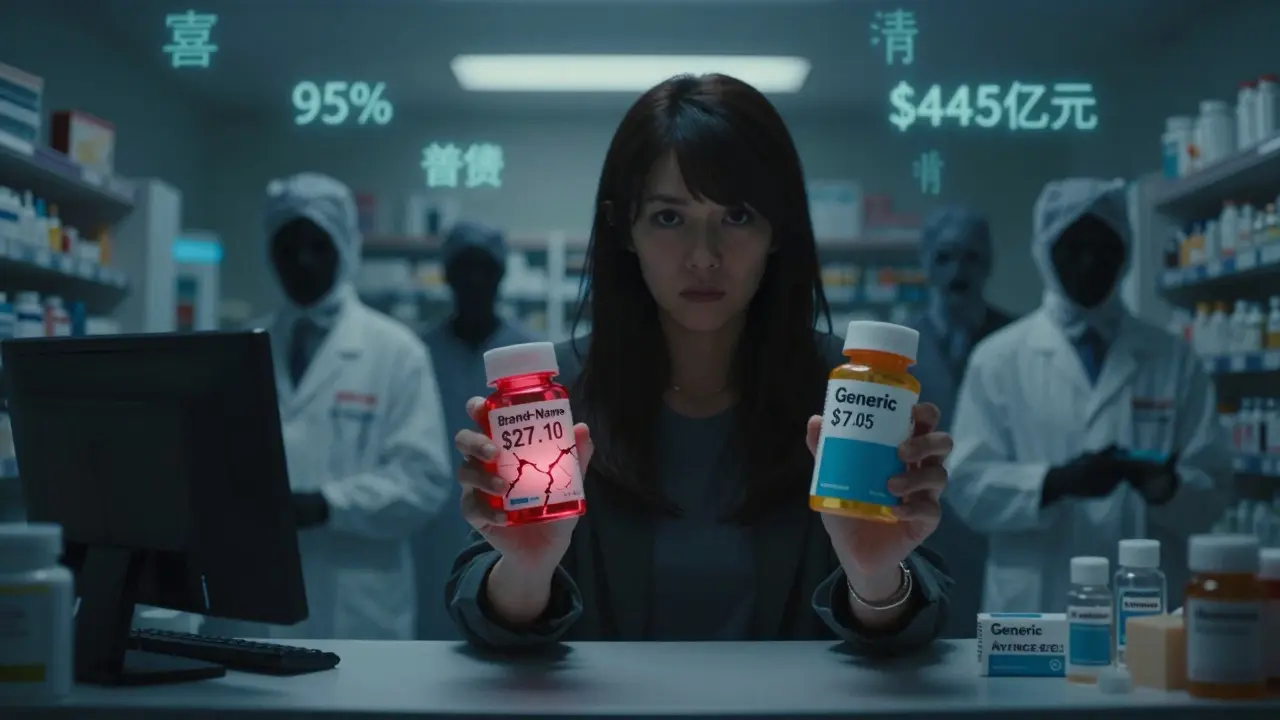
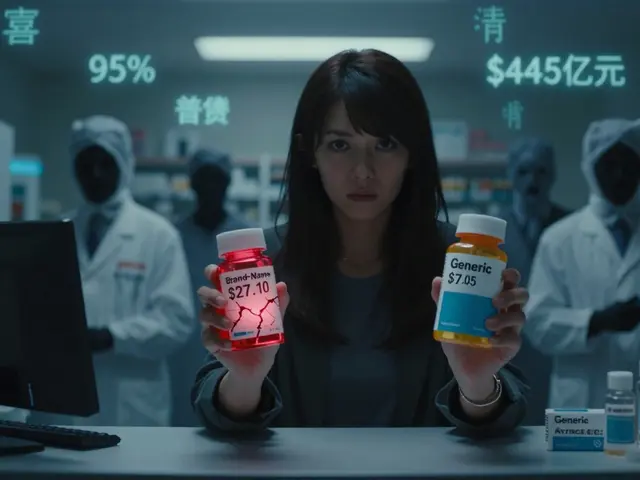
When you fill a prescription, what you pay at the counter isn’t the full price. It’s just your share-the out-of-pocket cost. And that number can swing wildly depending on whether you’re taking a brand-name drug or its generic version. In 2023, the average out-of-pocket cost for a generic drug was $7.05. For a brand-name drug? $27.10. That’s nearly four times more. For some medications, the difference is even starker.
How Much Do Generics Actually Save?
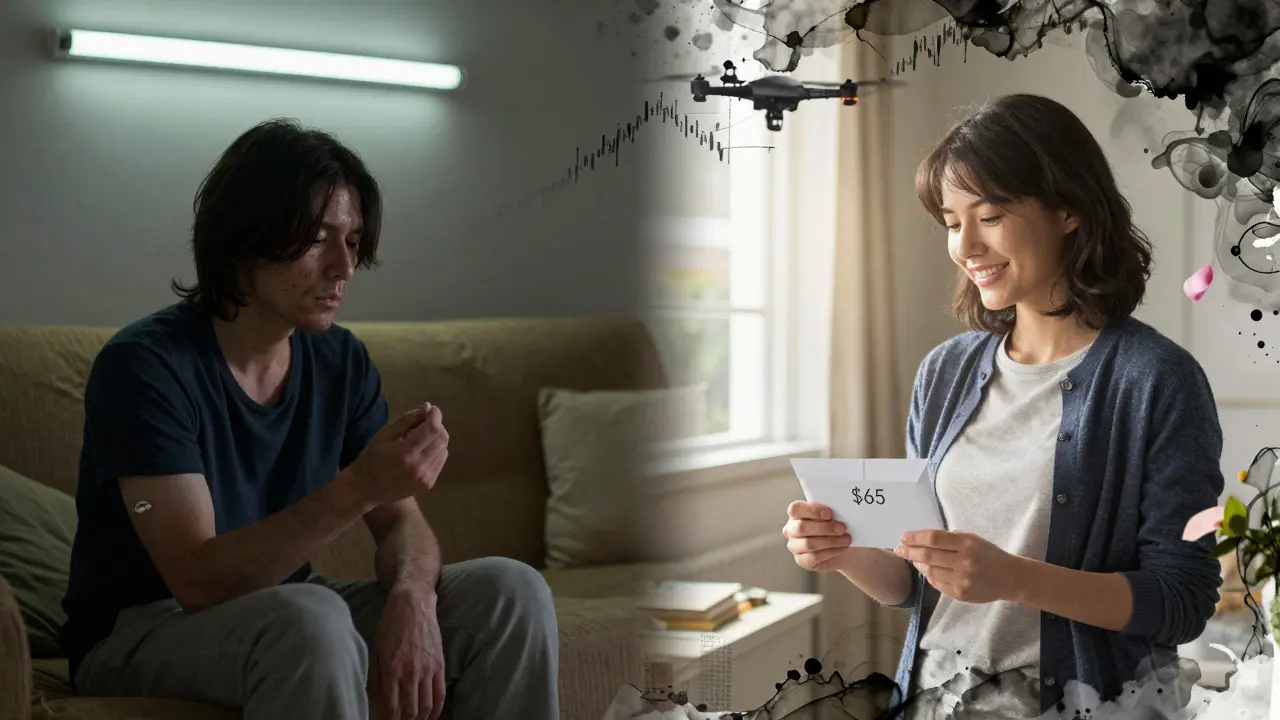
Think about this: in 2021, when the HIV medication efavirenz, emtricitabine, and tenofovir went generic, the 30-day cost dropped from around $1,000 to just $65. That’s a 94% drop. Same pills. Same effectiveness. Just a fraction of the price.
Another example: Sildenafil Citrate (the generic for Viagra). Before generics, one pill cost $49.90. Today, you can get it for $3.07. That’s not a sale. That’s a revolution in access.
According to the FDA’s 2022 analysis of new generic approvals, these kinds of price drops aren’t rare. They’re routine. And they’re adding up. In the decade ending in 2023, generic and biosimilar drugs saved U.S. patients $445 billion. That’s more than the GDP of most countries.
But here’s the kicker: 93% of all generic prescriptions cost $20 or less out-of-pocket. Over 82% are under $20. Nearly 99% are under $50. That’s not a guess. It’s based on 1.4 billion Medicare Part D claims analyzed by JAMA Internal Medicine.
Why Do Brand-Name Drugs Cost So Much More?
Brand-name drugs carry patent protection. That means only one company can make and sell them. No competition. No pressure to lower prices. So manufacturers set prices based on what the market will bear-not what it costs to produce.
Once the patent expires, generics flood the market. Dozens of companies start making the same drug. Suddenly, competition kicks in. Prices crash. And because generics don’t need to repeat expensive clinical trials, their production costs are far lower. That savings gets passed on.
But here’s where things get twisted: even though generics make up 90% of all prescriptions filled in the U.S., they account for only 13.1% of total drug spending. That means the system is still paying out way more for brand-name drugs than it should. And you’re often the one footing the bill.
Insurance Plans Are Making It Worse
You’d think insurance would help. But too often, it doesn’t. Many plans put generics on higher cost tiers-like tier 3 or 4-just because they’re cheaper. Why? Because insurers get kickbacks from brand-name manufacturers. They’re paid to steer patients toward expensive drugs, even when cheaper, equally effective generics exist.
One study tracking drugs from 2011 to 2019 found that when insurers moved generics to higher tiers, patient spending jumped by 135%. Meanwhile, average drug prices fell by 38%. So patients paid more-even as drugs got cheaper.
And it’s not just about copays. Medicare Part D, the federal drug plan for seniors, overspent by $2.6 billion in 2018 compared to what Costco charged for the same drugs. In over half of 90-day fills, Medicare patients paid more than Costco members-even without insurance.
Where You Buy Matters More Than You Think
Not all pharmacies charge the same. A 2023 NIH study compared prices at traditional retail pharmacies like Walgreens and CVS with direct-to-consumer (DTC) pharmacies like Health Warehouse and MCCPDC. The results were shocking.
- Pantoprazole 20mg: $44 at Albertsons. $9.20 at DTC pharmacy. 79% savings.
- Rosuvastatin 5mg: $110 at Walgreens. $7.50 at Health Warehouse. 93% savings.
DTC pharmacies cut costs by 75-76% on average. They skip middlemen. They buy in bulk. They pass savings directly to you. And they’re legal. No prescription fraud. No shady deals. Just straight-up lower prices.
But most people don’t know these options exist. They walk into their local pharmacy and pay what’s on the shelf. That’s like buying a car at MSRP when you could’ve ordered it online for half the price.
Why Don’t We Fix This?
The problem isn’t that generics don’t work. They do. They’re safe, effective, and widely used. The problem is the system. Rebates, pharmacy benefit managers (PBMs), and opaque pricing structures keep prices artificially high.
Here’s the strangest part: even though generic drug prices have been falling for years, patients are paying a higher share of the cost than they did a decade ago. From 2011 to 2016, consumers paid 41.8% of the cost for non-specialty generics-but only 32.1% for brand-name drugs. That’s backwards. Why pay more for the cheaper option?
Research from the USC Schaeffer Center found that while out-of-pocket payments for generics dropped by about 50%, total system costs (including what insurers paid) fell by nearly 80%. That means the difference? It went to middlemen-not patients.
When a drug goes generic, the savings should go to you. But instead, they often get trapped in insurance contracts, rebates, and pharmacy networks that prioritize profit over people.
What You Can Do Right Now
You don’t have to accept high prices. Here’s how to cut your out-of-pocket costs today:
- Ask for the generic. Always. Even if your doctor doesn’t mention it, your pharmacist can tell you if one exists.
- Compare prices. Use apps like GoodRx, SingleCare, or RxSaver. They show you prices at nearby pharmacies-and often list DTC options.
- Try DTC pharmacies. For chronic meds (like statins, blood pressure pills, or acid reflux drugs), ordering from a reputable DTC pharmacy can save you 75% or more.
- Check your Medicare Part D plan. If you’re on Medicare, compare your plan’s formulary with Costco’s prices. You might pay less without insurance.
- Ask about 90-day fills. Many plans charge less for 90-day supplies. But make sure the pharmacy isn’t overcharging.
These aren’t hacks. They’re basic steps anyone can take. And they work.
The Bottom Line
Generics are the most powerful tool we have to reduce drug costs. They’re not second-rate. They’re the same drug, made to the same standards, at a fraction of the price. Yet, due to broken systems and hidden fees, patients still overpay.
The data is clear: without generics, millions couldn’t afford their meds. With them, most prescriptions cost less than a coffee. But if you’re not shopping around, you’re paying more than you need to.
The system is rigged. But you’re not powerless. You just need to know where to look.
You might like
Chris Farley
Generics? Please. This whole 'generic equals same drug' myth is corporate propaganda. The FDA lets these companies cut corners on fillers and binders. You think your $3 sildenafil is identical to the $50 version? Tell that to the guy who got a rash from the generic and had to go back to brand. This isn't about savings-it's about control. Big Pharma doesn't want you to know generics are often made in factories with fewer inspections. You're not saving money-you're gambling your health.
Darlene Gomez
I love how this article frames generics as some kind of moral victory. But let’s be real-people aren’t choosing generics because they’re cheaper. They’re choosing them because their insurance won’t cover the brand. And sure, the math looks good on paper. But what about the people who switch and have a bad reaction? Or the ones who can’t afford to try three different generics before finding one that works? It’s not about price. It’s about access. And access isn’t just about cost-it’s about trust. We pretend science is neutral, but the system is rigged to make you feel lucky if you get a pill that doesn’t make you feel worse.
Jacob Hessler
generic is just a word. they dont even make the same stuff. i got my blood pressure med from walmart for $5 and my heart felt like it was gonna explode. had to go back to brand. 100 bucks a month. worth it. they just want you to die cheap. also why is everyone acting like dtc pharmacies are legit? they ship from china. i dont trust my life to a package with no tracking number. america is falling apart.
Amber Gray
bruh i just use goodrx and get my meds for $3 at cvs 😎💸 why are we even having this conversation? also someone please tell my mom shes not getting her insulin from walmart. she thinks its magic.
Danielle Arnold
Wow. A 95% cost reduction. I’m so moved. Next up: ‘How to Save 99% on Your Car by Using a Bicycle.’
James Moreau
It’s fascinating how this piece highlights the systemic issues without blaming individuals. The real tragedy isn’t that generics are cheaper-it’s that we’ve normalized the idea that health should be a bargain. People don’t realize that the same $3 pill that saved them from bankruptcy could’ve been $0 if the supply chain wasn’t so fractured. We need policy, not just apps. But hey, at least we’re talking about it. That’s something.
Blessing Ogboso
As someone from Nigeria, where even basic generics are often unavailable or unaffordable, I see this as both a blessing and a warning. In my home country, people wait months for essential medicines, and when they do arrive, they’re often counterfeit or expired. The fact that in the U.S., a 94% price drop is even a conversation-this is progress. But I also see how easily this system exploits the vulnerable. When insurers manipulate tiers, when pharmacies hide prices, when DTC sites operate in legal gray zones-it’s not innovation. It’s survival. And survival shouldn’t require a PhD in pharmacy navigation. We need transparency, not just savings. Real access means knowing what you’re getting, where it came from, and why it costs what it does. Not just how low the number is on the receipt.
Jefferson Moratin
The data presented is statistically sound, but the underlying assumption-that patients are rational actors in a competitive market-is fundamentally flawed. The market for pharmaceuticals is not competitive; it is monopolistic until patent expiration, then artificially fragmented by PBM contracts and tiered formularies. The $445 billion in savings cited does not reflect consumer benefit-it reflects redistribution from insurers to middlemen. The real metric is not out-of-pocket cost, but total system cost per patient outcome. And here, the system is failing. Generics are not the solution; they are a symptom of a deeper pathology: the commodification of health. Until we decouple drug pricing from profit motives and restructure reimbursement to prioritize efficacy and equity, we are merely rearranging deck chairs on the Titanic.