
Small Intestinal Bacterial Overgrowth: Breath Tests and Treatment Explained


When your gut feels off-bloating after a light meal, gas that won’t quit, diarrhea or constipation that comes and goes-you might blame stress, food intolerance, or IBS. But what if the real problem is too many bacteria in the wrong place? That’s Small Intestinal Bacterial Overgrowth, or SIBO. It’s not rare. In fact, up to 80% of people diagnosed with IBS may actually have SIBO. The problem isn’t just that bacteria are present-it’s that they’re in the small intestine, where they don’t belong in large numbers. This triggers inflammation, damages the gut lining, and messes with nutrient absorption. And the most common way to find out if you have it? A simple breath test.
How SIBO Happens
Your small intestine is meant to be mostly clean. It’s where nutrients get absorbed, not where bacteria ferment food. Normally, stomach acid, bile, and the movement of your gut keep bacteria in check. But when those systems slow down or break, bacteria from the colon creep up and multiply. That’s SIBO.It doesn’t happen for no reason. Surgery that changes how food moves through your gut-like gastric bypass or removal of the ileocecal valve-is a major trigger. So is long-term use of proton pump inhibitors (PPIs), the common acid-reducing drugs. Studies show people on PPIs have 2 to 3 times higher risk of SIBO. Older adults with low stomach acid, people with diabetes causing slow gut motility, and those with liver disease or scleroderma are also at higher risk.
And here’s the twist: SIBO and IBS overlap heavily. Many people treated for IBS for years never got tested for SIBO. When they finally are, a big chunk test positive. That’s why doctors now consider SIBO a possible root cause behind symptoms labeled as IBS.
What Breath Tests Actually Measure
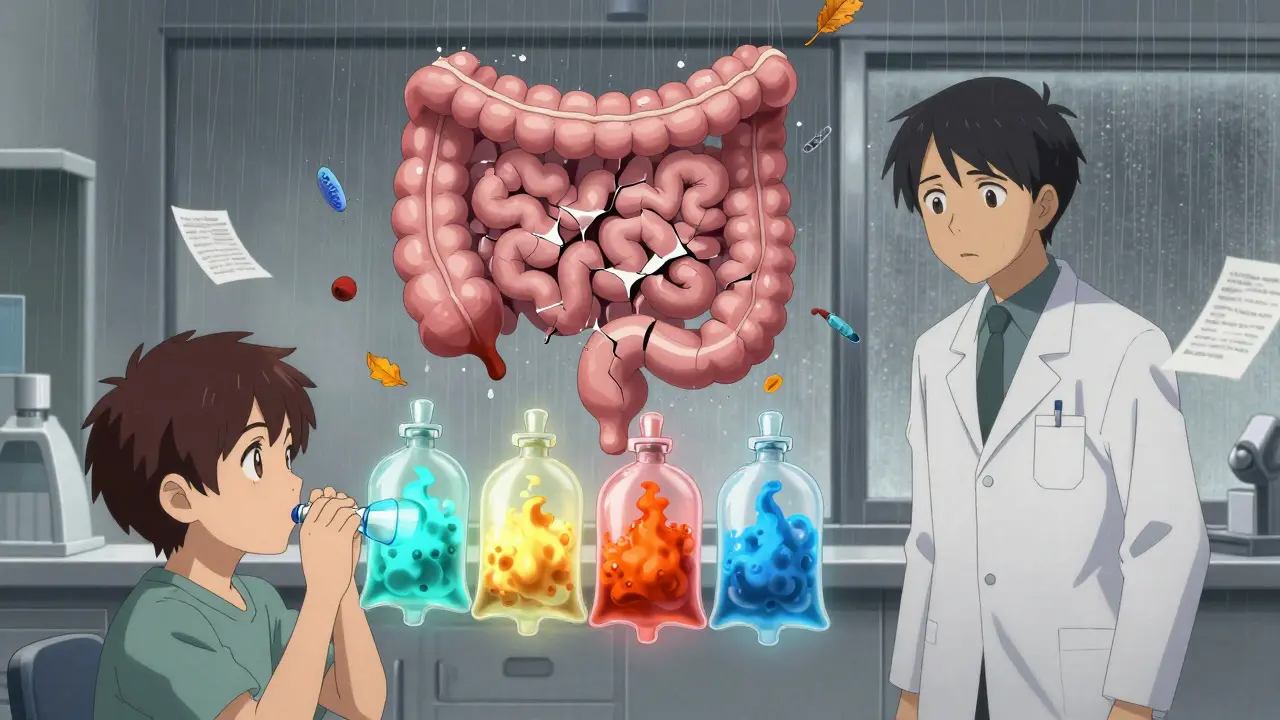
The go-to test for SIBO is the breath test. It’s non-invasive, cheap, and widely available. But it’s not perfect. Here’s how it works: you drink a sugar solution-either glucose or lactulose-and then blow into a bag every 15 to 20 minutes for up to two hours.The bacteria in your small intestine eat that sugar and produce gases-mainly hydrogen and methane. Those gases get absorbed into your blood, then come out through your lungs. The machine measures how much gas is in your breath. A rise of 20 ppm in hydrogen or 10 ppm in methane above your baseline level within 90 to 120 minutes usually means SIBO.
There are two types of tests. Glucose breath test (GBT) is better at catching SIBO in the first part of the small intestine because glucose gets absorbed quickly. But if the bacteria are further down, glucose might miss them. Lactulose breath test (LBT) travels farther, so it’s more likely to catch overgrowth in the lower small intestine. But it’s also more prone to false positives because lactulose can be fermented by normal colon bacteria if it moves too fast.
Studies show glucose breath tests are about 83% specific-meaning if you test positive, it’s likely real. But they only catch about 46% of actual cases. Lactulose is better at finding cases (62% sensitivity) but less accurate at ruling them out (71% specificity). That’s why many labs now test for both hydrogen and methane. Methane is linked to constipation-predominant SIBO, and it responds differently to treatment.
Why Breath Tests Can Be Misleading
A lot of people get false results. Why? Because breath tests don’t see bacteria-they see gas. And gas can come from other places.First, if you don’t fast properly. You must fast for 12 hours before the test. Eat anything-even a piece of gum-and you’ll skew the results. You also can’t take antibiotics for four weeks before, or probiotics, laxatives, or prokinetics for seven days. Many patients skip these steps and wonder why their test is inconclusive.
Second, some people don’t produce hydrogen. About 15-20% of the population are non-hydrogen producers. Their bacteria make mostly methane or hydrogen sulfide. If the lab only checks for hydrogen, they’ll get a false negative. That’s why methane testing is now standard.
Third, rapid transit can trick the test. If food moves too fast through your gut, the sugar reaches the colon before it’s absorbed. Colon bacteria ferment it, and you get a spike in gas-even if you don’t have SIBO. This happens in 10-15% of cases, especially in IBS-D patients.
And here’s the biggest issue: breath tests can’t tell you what kind of bacteria are overgrowing. They can’t tell you if they’re resistant to antibiotics. That’s why some experts, like Dr. Hisham Hussan at UC Davis Health, say breath tests are only 60% accurate. He uses endoscopic fluid sampling as the gold standard. But that’s expensive, invasive, and only available in a few centers.
What Comes After a Positive Test
If your breath test comes back positive, treatment starts with antibiotics. The most common is rifaximin (Xifaxan), taken at 1,200 mg per day for 10 to 14 days. It works because it stays in the gut and doesn’t get absorbed into your bloodstream. Studies show it helps 40-65% of patients. But here’s the catch: more than 40% of people relapse within nine months.For methane-dominant SIBO (constipation), rifaximin alone isn’t enough. Doctors add neomycin or metronidazole to the regimen. Combination therapy works better-up to 70% success in some trials.
Antibiotics aren’t the only option. Some patients try herbal antimicrobials like oregano oil, berberine, or garlic extract. A 2020 study in the American Journal of Gastroenterology found herbal treatments worked just as well as rifaximin in some cases, with fewer side effects. But they’re not regulated, so quality varies.
After antibiotics, you need to prevent recurrence. That means fixing the root cause. If you’re on PPIs, talk to your doctor about tapering. If your gut motility is slow, prokinetics like low-dose erythromycin or prucalopride may help. Diet matters too. A low-FODMAP diet reduces fermentable carbs that feed bacteria. But it’s not a cure-it’s a tool to manage symptoms while you fix the underlying issue.
The Future of SIBO Testing
The field is changing fast. Researchers at Cedars-Sinai are testing a new breath analyzer that claims 85% accuracy by detecting multiple gases at once, including hydrogen sulfide. Mayo Clinic and Johns Hopkins are working on devices that sample gas directly from the small intestine using tiny capsules-no endoscopy needed.Next-generation sequencing might one day identify exact bacterial strains from stool or breath samples, letting doctors pick targeted antibiotics. Right now, we’re guessing. With better tools, we’ll move from trial-and-error to precision treatment.
For now, breath testing is the best tool we have. It’s not perfect, but it’s accessible. And for many people, it’s the first step to finally understanding why they’ve felt unwell for years.
What You Should Do If You Suspect SIBO
If you’ve had bloating, gas, diarrhea, or constipation for months-or years-and standard IBS treatments haven’t helped, ask your doctor about SIBO testing. Don’t assume it’s just stress or food sensitivity.Here’s what to do:
- Stop PPIs, antibiotics, and laxatives as directed by your doctor (usually 4 weeks before testing).
- Fast for 12 hours before the test. No food, no gum, no smoking.
- Ask if the lab tests for both hydrogen and methane.
- Make sure they use standardized protocols-20 ppm hydrogen or 10 ppm methane rise.
- After treatment, follow up with a repeat test in 4-6 weeks to confirm clearance.
- Work with a provider who understands SIBO isn’t just a “gut bug”-it’s a motility or structural issue needing long-term management.
SIBO is treatable. But you need the right test, the right treatment, and the right follow-up. Don’t settle for vague labels like IBS if your symptoms don’t fit. Ask for the breath test. It might be the key you’ve been missing.
You might like

Akshaya Gandra _ Student - EastCaryMS
so i took the breath test last month and got a positive for methane... but i didnt fast right cause i was hungry and ate a banana before... now im confused if it was real or not. anyone else mess up the prep and still get a weird result?
Joseph Snow
Let me guess-you’re all excited about breath tests like they’re some kind of divine revelation. Newsflash: they’re not. The whole SIBO industry is a $3 billion scam built on placebo effects and overworked gastroenterologists who’d rather prescribe antibiotics than admit they don’t know what’s going on. You think bacteria in your small intestine are the problem? Maybe it’s your fear of food, your chronic stress, or the fact that you’ve been drinking kombucha like it’s holy water. The real diagnosis? You’re anxious. And now you’re buying supplements.
Vicki Yuan
Just wanted to say-thank you for the detailed breakdown on glucose vs. lactulose tests. I’ve been reading conflicting info for months and this clarified it perfectly. Also, the part about methane = constipation? That’s me. I thought I had IBS-C for 7 years. Turns out, I just had a bacterial party in my ileum.
saurabh singh
Hey from India! We don’t have breath tests everywhere here, but my cousin in Delhi got tested last year and it changed everything. She was on PPIs for acid reflux for 5 years and never knew it could cause SIBO. Now she’s off meds, on low-FODMAP, and taking probiotics after antibiotics. It’s not magic, but it works if you stick with it. Also, oregano oil is way cheaper than Xifaxan-just don’t swallow it straight, lol.
John Wilmerding
As a clinical nutritionist with over 15 years in GI care, I must emphasize that while breath testing is imperfect, it remains the most accessible and clinically useful tool available in primary care settings. The key is not to treat the test result in isolation, but to correlate it with symptom history, dietary patterns, and motility markers. I’ve seen patients misdiagnosed with IBS for a decade, only to find resolution after targeted antimicrobial therapy and prokinetic support. The future lies in multimodal diagnostics, but for now, this is the best we have-and it’s better than nothing.
bob bob
I had the test. Positive for hydrogen. Took rifaximin. Felt better for 3 months. Then back to bloating like nothing happened. Now I’m on herbal stuff-berberine, garlic, peppermint. Feels less like a chemical assault and more like my gut’s getting a massage. Still not 100%, but I’m not crying in the bathroom anymore. Progress, not perfection.
Cassie Tynan
So we’re now diagnosing modern suffering as ‘bacteria in the wrong place’? Brilliant. Next they’ll tell me my existential dread is just a lack of probiotics. I’m not sick-I’m a product of late-stage capitalism, poor sleep, and too much screen time. But sure, let’s just pump me full of antibiotics and call it a day. Meanwhile, the real problem? We’ve outsourced our health to a pill.
Aaron Mercado
STOP. STOP. STOP. People are dying because they’re trusting these breath tests like they’re gospel! Did you know the FDA hasn’t even approved the algorithm for methane detection? And the labs? Half of them are run by tech grads who learned how to run the machine from a YouTube video! I had a friend who got a false positive, took antibiotics, lost 20 pounds, and now has C. diff. This isn’t medicine-it’s a casino. And you’re all betting your guts on it.
Enrique González
Just wanted to say-I was skeptical too. Thought SIBO was just a fad. But after 4 years of bloating, I finally got tested, did the 10-day rifaximin, and added prucalopride for motility. My energy came back. I can eat broccoli again. It’s not a cure-all, but it’s a real path forward. Don’t give up. You’re not broken-you’re just out of balance.
Peyton Feuer
My doctor didn’t even mention methane testing until I asked. I’m so glad I did. I had a negative hydrogen test, but methane was sky-high. That’s why I was constipated all along. Also-fasting for 12 hours? Hard. But worth it. Don’t skip it. And if your lab doesn’t test for methane, find another one. Seriously.
Uzoamaka Nwankpa
I’ve been reading this whole post and I feel so seen. I’ve been ignored by doctors for years. They said it was stress. I was told to ‘just relax.’ But my gut has been screaming. I’m tired of being told I’m too sensitive. Maybe I am. But my pain isn’t imaginary.
Chris Cantey
Isn’t it ironic? We’ve reduced the complexity of human biology to a gas reading, while ignoring the soul’s role in digestion. The gut is not a pipe. It’s a mirror. Your bacteria reflect your silence, your unprocessed grief, your fear of being seen. Antibiotics won’t heal that. Only presence will. But of course, no one wants to pay for therapy when they can just buy a pill.