
Stability Testing Requirements: Temperature and Time Conditions for Bioequivalence

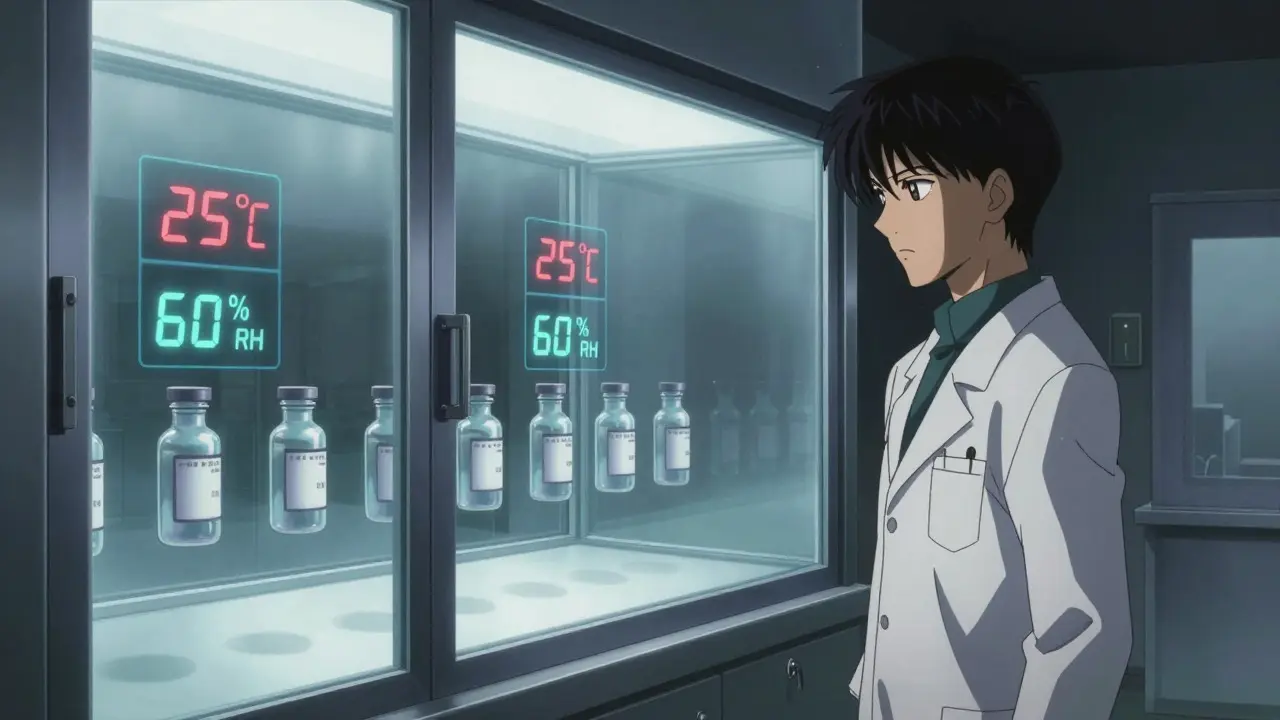
Imagine spending millions developing a life-saving drug, only to have regulators reject it because your stability data didn't match the exact temperature and time requirements. It happens more often than you might think. Stability testing isn't just a bureaucratic checkbox; it is the scientific proof that your medicine remains safe, effective, and potent from the factory floor to the patient's hands. For anyone navigating bioequivalence standards or pharmaceutical development, understanding the precise temperature and time conditions mandated by global guidelines is non-negotiable.
The rules governing these tests are strict, harmonized across major markets like the US, EU, and Japan, yet filled with nuances that can trip up even experienced teams. Whether you are formulating a new generic drug or managing quality control for a biologic, getting these parameters wrong means delays, recalls, or worse-patient harm. Let’s break down exactly what the regulations demand, why they matter, and how to execute them without falling into common traps.
Why Stability Testing Matters in Bioequivalence
At its core, stability testing answers one critical question: How does your product change over time? In the context of bioequivalence, this is vital. If a generic drug degrades faster than the reference listed drug (RLD) under identical storage conditions, it may not deliver the same therapeutic effect. Regulatory bodies like the FDA and EMA require this data to establish shelf life, storage conditions, and retest periods.
Without robust stability data, you cannot prove that your product maintains its chemical identity, strength, quality, and purity throughout its intended lifespan. The International Council for Harmonisation (ICH) established these standards to ensure consistency globally. The current gold standard is ICH Q1A(R2), which was finalized in 2003 and remains the backbone of regulatory submissions worldwide. This guideline dictates not just what to test, but the exact environmental conditions under which those tests must occur.
Core Temperature and Humidity Conditions
The ICH guidelines define specific climate zones based on global weather patterns. Your choice of testing conditions depends largely on where you plan to sell the product. However, for most small-molecule drugs targeting temperate or Mediterranean climates, two primary protocols dominate: long-term and accelerated testing.
| Test Type | Temperature | Relative Humidity (RH) | Duration |
|---|---|---|---|
| Long-Term (Zone II) | 25°C ± 2°C | 60% RH ± 5% RH | Minimum 12 months at submission |
| Accelerated | 40°C ± 2°C | 75% RH ± 5% RH | 6 months |
| Intermediate | 30°C ± 2°C | 65% RH ± 5% RH | Required if significant change occurs in accelerated |
Let’s unpack these numbers. The long-term condition of 25°C/60% RH represents typical room temperature storage in many parts of the world. You must monitor your product here for at least 12 months before submitting your application to the FDA. The European Medicines Agency (EMA) offers some flexibility, allowing either 6 or 12 months depending on the submission option, but aiming for 12 months avoids unnecessary back-and-forth.
Accelerated testing at 40°C/75% RH is designed to stress the product. Think of it as a fast-forward button. By exposing the drug to higher heat and humidity, you can predict how it will behave over years in a much shorter timeframe. This six-month window helps identify rapid degradation pathways. If your product shows "significant change" during this phase-defined generally as a 5% shift in assay value or other key attributes-you trigger the need for intermediate testing.
Understanding Significant Change and Intermediate Testing
What exactly constitutes "significant change"? This is where many companies stumble. The ICH guidelines don’t provide a rigid mathematical formula for every scenario, leading to subjective interpretations. Generally, a 5% change in the main assay result from the initial value is the threshold. However, changes in impurities, dissolution profiles, or physical appearance also count.
If your product fails the accelerated test but passes the long-term test, you must run an intermediate study at 30°C/65% RH. This acts as a bridge, helping regulators understand the product’s true stability profile. It’s crucial to document any deviations meticulously. A case study from Merck highlighted how intermediate testing identified a polymorphic transition in a key drug candidate, preventing potential bioavailability issues in tropical markets. Without that extra step, the product might have failed post-launch.

Climatic Zones and Regional Variations
Not all markets have the same climate. The ICH divides the world into five climatic zones, each with specific long-term storage recommendations:
- Zone I (Temperate): 21°C / 45% RH (e.g., Northern Europe, Canada)
- Zone II (Mediterranean/Subtropical): 25°C / 60% RH (e.g., Southern Europe, USA)
- Zone III (Hot-Dry): 30°C / 35% RH (e.g., Middle East)
- Zone IVa (Hot-Humid/Tropical): 30°C / 65% RH (e.g., Southeast Asia, Latin America)
- Zone IVb (Hot-Higher Humidity): 30°C / 75% RH (e.g., Parts of Africa, India)
If you are launching a generic drug in Zone IV countries, you cannot rely solely on Zone II data. Regulators in these regions often require additional stability studies conducted at 30°C/65% RH or even 30°C/75% RH. Ignoring this can lead to rejected applications or mandatory post-approval studies that delay market entry by months. For global launches, companies often run parallel studies to satisfy both FDA and regional health authorities simultaneously.
Refrigerated Products and Special Cases
Biologics, vaccines, and certain insulin formulations require cold chain management. Their stability protocols differ significantly from ambient-stored drugs. According to WHO Annex 10 to ICH guidelines, refrigerated products undergo long-term testing at 5°C ± 3°C. There is no humidity requirement for sealed containers, but open systems must account for moisture.
Accelerated testing for refrigerated items typically occurs at 25°C/60% RH, not the standard 40°C. Why? Because exposing a cold-chain product to 40°C might cause irreversible denaturation or precipitation, providing useless data. Instead, the goal is to simulate temperature excursions during transport. Some companies opt for 30°C/65% RH if justified by risk assessment. Always consult the specific monograph for your product type, as biologics often have unique degradation pathways unrelated to simple hydrolysis or oxidation.

Common Pitfalls and Practical Tips
Even with clear guidelines, execution errors are common. Here are three frequent mistakes and how to avoid them:
- Chamber Calibration Failures: Your stability chamber must maintain temperature within ±0.5°C and humidity within ±2% RH. Many labs fail because they neglect regular mapping. Use calibrated sensors placed at multiple points inside the chamber to detect hot spots. If your chamber fluctuates beyond these limits, your entire dataset could be invalidated.
- Inadequate Sampling Frequency: The standard schedule is 0, 3, 6, 9, 12, 18, 24, and 36 months. Don’t skip early time points. Degradation often happens fastest in the first six months. Missing a critical change at month 3 can skew your predictive models and lead to incorrect shelf-life assignments.
- Packaging Discrepancies: Test the product in its final commercial packaging. Using different blister packs or bottle seals during stability testing compared to market release can yield misleading results. Moisture permeability varies widely between materials, affecting hygroscopic drugs significantly.
Another pro tip: invest in real-time monitoring systems. Manual logging is prone to human error. Automated data loggers provide continuous records, making it easier to defend your data during regulatory audits. When the FDA asks for evidence of temperature control, a digital trail is far more convincing than handwritten logs.
The Future of Stability Testing
The landscape is evolving. Traditional ICH Q1A(R2) guidelines were written decades ago, primarily for small molecules. Today, complex biologics, mRNA vaccines, and antibody-drug conjugates challenge these norms. The FDA has piloted programs using Process Analytical Technology (PAT) to assess stability in real-time, potentially reducing testing duration by up to 50% for continuously manufactured products.
Additionally, predictive modeling is gaining traction. Companies are using high-temperature accelerated studies (50-80°C) combined with kinetic modeling to estimate shelf life faster. While regulators remain cautious, the trend toward risk-based approaches is undeniable. Expect updates to ICH guidelines in the coming years to address these modern delivery systems. Staying ahead means not just following current rules, but anticipating where the science is heading.
How long must stability data be collected before FDA submission?
The FDA requires a minimum of 12 months of long-term stability data at the time of submission for new drug applications. This ensures that the product’s shelf life and storage conditions are well-supported by real-time evidence.
What is the difference between accelerated and long-term stability testing?
Long-term testing simulates normal storage conditions (e.g., 25°C/60% RH) to determine actual shelf life. Accelerated testing uses harsher conditions (40°C/75% RH) to stress the product and predict degradation rates quickly, usually over six months.
When is intermediate stability testing required?
Intermediate testing at 30°C/65% RH is required if significant change occurs during accelerated testing but the product remains stable under long-term conditions. It helps clarify the product’s true stability profile.
Do biologics follow the same stability testing guidelines as small molecules?
No. Biologics often require refrigerated storage (5°C ± 3°C) and different accelerated conditions (typically 25°C/60% RH). They are more sensitive to temperature excursions and freezing, requiring specialized protocols.
What defines "significant change" in stability testing?
Significant change is generally defined as a 5% shift in the assay value from the initial mean. It can also include notable increases in impurities, changes in dissolution, or physical alterations like discoloration or cracking.
You might like