
Sudden Sensorineural Hearing Loss: Urgent Steroid Therapy


When your hearing drops overnight - like someone turned down the volume on the world - it’s not just startling. It’s terrifying. Sudden sensorineural hearing loss (SSNHL) doesn’t come with warning signs. One day you hear the kettle whistle; the next, silence. And if you wait too long to act, that silence might become permanent.
SSNHL is defined as a drop of at least 30 decibels in hearing across three connected frequencies, happening within 72 hours. That’s not a gradual fade. It’s a blackout. About 5 to 27 people out of every 100,000 experience this each year, mostly between ages 50 and 60, but it can strike anyone. And here’s the brutal truth: without treatment, only 32% to 65% of people recover their hearing on their own. The rest? They’re left with permanent hearing damage.
Why Time Is Everything
Every hour counts. The window for effective treatment is narrow - and it closes fast. Studies show that if you start steroid treatment within two weeks, 61% of patients recover significant hearing. If you wait four weeks? That number drops to 19%. Beyond six weeks? There’s virtually no benefit. This isn’t a "wait and see" situation. It’s a medical emergency.
Why the rush? The inner ear - the cochlea - is a delicate, blood-rich organ. SSNHL is thought to involve inflammation, immune overreaction, or reduced blood flow. Steroids don’t cure the cause. But they calm the storm. They reduce swelling, quiet the immune system, and may help restore blood flow to the hair cells that turn sound into signals your brain understands.
Oral Steroids: The First Line
The go-to treatment? Oral corticosteroids. Specifically, prednisone. The standard dose is 1 mg per kilogram of body weight per day - usually capped at 60 mg daily - taken as a single morning dose. You take it for 7 to 14 days, then taper slowly over the same period. Why taper? To avoid adrenal crash. Suddenly stopping steroids can make you feel like you’ve been hit by a truck: fatigue, nausea, dizziness.
Another option is dexamethasone. It’s stronger - 5 to 7 times more potent than prednisone - and lasts longer in your system (36 to 72 hours vs. 18 to 36). But studies show both drugs work about the same. Prednisone is cheaper, more available, and easier to prescribe. Dexamethasone? It’s often reserved for patients who can’t tolerate prednisone’s side effects.
Recovery rates? Between 47% and 62% of people on oral steroids see partial or full hearing return. That’s better than waiting. But it’s not a guarantee.
What If Oral Steroids Don’t Work?
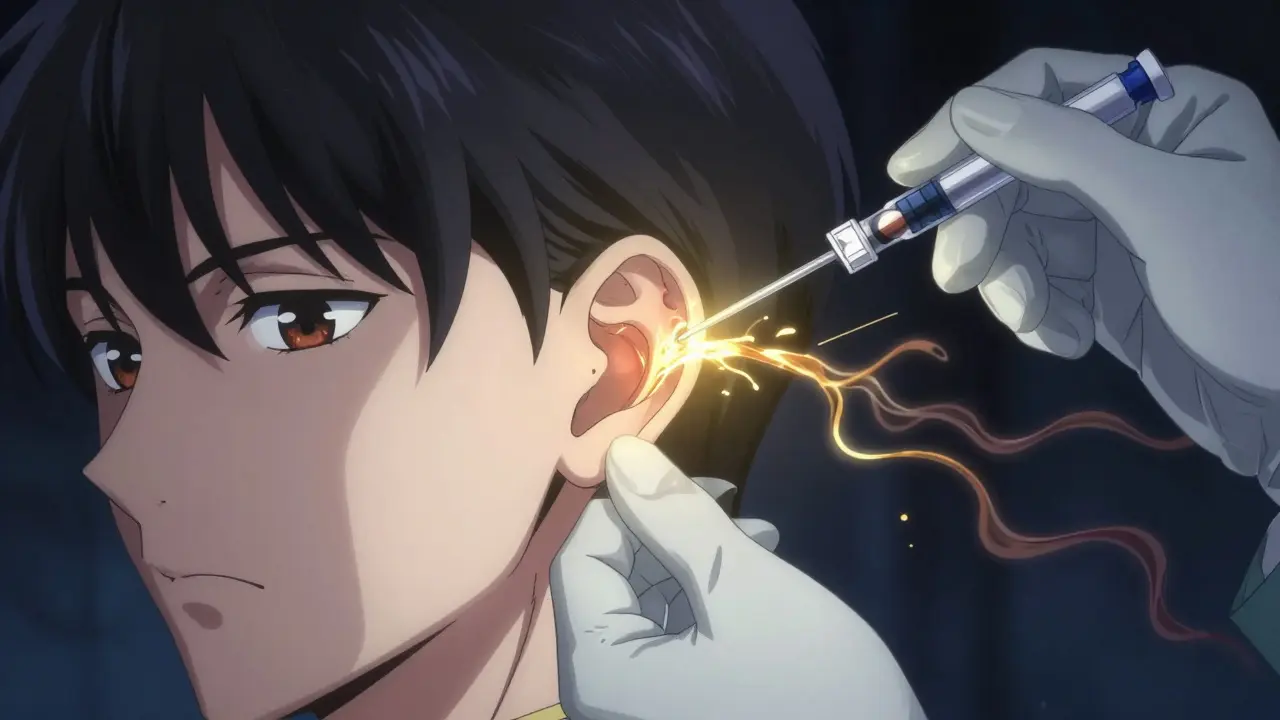
Some people don’t respond to pills. That’s where intratympanic (IT) steroid injections come in. This isn’t a shot in the arm. It’s a needle through the eardrum, delivering dexamethasone directly into the middle ear. From there, it seeps into the inner ear - bypassing the whole body. No stomach upset. No mood swings. No blood sugar spikes.
The dose? Usually 24 mg per ml of dexamethasone, injected once a week for 2 to 4 weeks. Studies show 42% to 65% of patients who didn’t respond to oral steroids get meaningful hearing improvement with IT injections. It’s not magic. But it’s often the last shot before permanent loss.
Is it painful? Yes. Patients report 8 out of 10 pain during the injection. It’s quick - under a minute. And yes, it’s messy. You’ll need to lie still for 20 minutes afterward. But for many, it’s worth it. One Reddit user wrote: "IT injections saved my hearing after oral steroids failed. The pain? Barely a memory compared to losing my hearing."
The Side Effects You Can’t Ignore
Oral steroids aren’t candy. A 60 mg daily dose for two weeks can wreck your body if you’re not careful. Here’s what actually happens:
- Insomnia: 41% of patients can’t sleep. Even with melatonin.
- Weight gain: Average 4.7 kg in two weeks. Mostly water, but it feels like fat.
- High blood sugar: 28% of diabetics spike dangerously. Some need insulin adjustments.
- Mood swings: Anxiety, irritability, even panic attacks. 22% report this.
- Stomach issues: 18% need proton pump inhibitors just to avoid ulcers.
These aren’t rare. They’re common. And they’re why some patients - especially those with diabetes, high blood pressure, or a history of depression - are pushed toward IT injections from the start. No systemic side effects. Just local action.
What Doesn’t Work
There’s a lot of noise out there. Antivirals? No. Thrombolytics? No. Hyperbaric oxygen? Maybe - but barely. A few studies show a 6% to 12% extra benefit when HBOT is added to steroids. But it costs $200 to $1,200 per session. And you need to start within 28 days. Plus, only 37% of U.S. hospitals have the chambers.
Meta-analyses of 15+ studies confirm: antivirals, blood thinners, and vasodilators do nothing better than placebo. The American Academy of Otolaryngology says they’re not recommended. Period.
How Doctors Diagnose It
Most patients first go to their GP or ER. They’re told it’s an ear infection or earwax. That’s dangerous.
Doctors need to do two quick tests:
- Weber test: A tuning fork placed on the forehead. If it sounds louder in the bad ear, it’s conductive hearing loss (earwax, fluid). If it sounds louder in the good ear? That’s sensorineural - the red flag.
- Rinne test: The fork is placed behind the ear, then near the ear canal. If air conduction is worse than bone conduction? That’s sensorineural damage.
But these are just screens. The only real diagnosis? An audiogram. And it must be done within 72 hours. If you’re not referred for one, ask again. Push. Because without it, you’re flying blind.
Insurance, Access, and Real-World Barriers
Here’s the ugly part: even when you know what to do, getting it done isn’t easy.
Insurance often denies IT injections. In 42% of cases, prior authorization is required - and denied. You might wait weeks just to get approval. That’s weeks you can’t afford to lose.
And in rural areas? Audiologists are scarce. Steroid prescriptions? Easy. Follow-up audiograms? Not so much. A 2021 malpractice study found that 23% more lawsuits happened when follow-up hearing tests weren’t documented. Doctors know this. So they push hard for the tests.
Cost-wise, oral steroids are dirt cheap - $5 to $15 for a full course. IT injections? $200 to $400. But they’re often cheaper than the long-term cost of hearing aids or cochlear implants.
What’s Next?
The 2024 Military Health System updated its guidelines to standardize prednisone at 60 mg/day for 14 days with taper. That’s now the gold standard. And the 2025 guideline update is expected to include biomarkers - blood tests that predict who will respond to steroids.
Early trials are looking at inflammatory markers like CRP and IL-6. If you have high levels? You’re likely a steroid responder. Low levels? Maybe you need something else. Personalized treatment is coming. But for now, steroids are still the only proven option.
As one expert put it: "We don’t have proof steroids always work. But we have proof that hearing loss without treatment is devastating. The risk of treating? Manageable. The risk of not treating? Irreversible."
What to Do Right Now
If you or someone you know suddenly loses hearing - even if it’s just in one ear - do this:
- Call an ENT immediately. Don’t wait. Don’t call your GP first. Go straight to an ear specialist.
- Ask for an audiogram within 72 hours. Insist on it.
- Start oral steroids (prednisone 60 mg/day) the same day if you can’t get an appointment right away. Don’t wait for the test to begin treatment.
- If no improvement after two weeks, ask about intratympanic injections.
- Document everything. Keep copies of the audiogram, prescription, and follow-up results.
There’s no time for second opinions. No time for "maybe." Your hearing is on the line. Act now. Not tomorrow. Not next week. Today.
Can sudden hearing loss fix itself without treatment?
Yes, but rarely. About one-third to two-thirds of people recover some hearing on their own. But the rest face permanent loss. Since the difference between recovery and permanent damage often comes down to timing, waiting is a gamble you can’t afford.
Are steroid side effects dangerous?
For most healthy people, the two-week course of oral steroids is safe. But for those with diabetes, high blood pressure, or mental health conditions, risks rise sharply. High blood sugar, severe insomnia, mood swings, and stomach ulcers are common. That’s why intratympanic injections - which avoid the bloodstream - are often recommended for these patients.
How soon should I start steroids after hearing loss?
Start within 72 hours - ideally on the same day. Recovery rates drop sharply after two weeks. Even if you’re waiting for an audiogram, begin oral steroids immediately. You can always stop if tests show another cause. But if you delay, you may lose the chance to recover hearing forever.
Do I need an MRI for sudden hearing loss?
Not always. MRI is recommended if hearing doesn’t improve with treatment, or if there are other neurological symptoms like dizziness, facial weakness, or headaches. In most cases, SSNHL is idiopathic - meaning no clear cause is found. But if you’re under 40 or have asymmetrical hearing loss, an MRI may be used to rule out tumors like acoustic neuroma.
Can I use over-the-counter hearing aids instead of steroids?
No. Hearing aids amplify sound - they don’t treat the underlying damage. If your hearing loss is sudden and sensorineural, the problem is in the inner ear’s nerve cells or blood supply. Only steroids (or injections) can help reverse the inflammation or blockage. Hearing aids are for long-term loss, not emergencies.
Is intratympanic injection safe?
Yes, when done by a trained specialist. The procedure involves numbing the eardrum and injecting steroid directly into the middle ear. Complications are rare - minor ear pain, temporary dizziness, or a small perforation that heals on its own. Serious infection or hearing damage is extremely uncommon. It’s far safer than long-term oral steroids for high-risk patients.
Why don’t all doctors know about SSNHL?
Most primary care doctors aren’t trained to recognize sudden hearing loss as an emergency. They see it as an ear infection or wax buildup. Studies show only 76% of community clinics follow the official guidelines, compared to 92% of academic centers. If your doctor dismisses you, ask for an ENT referral. If they refuse, go to an urgent care center or ER - and demand an audiogram.
You might like

Kenneth Zieden-Weber
So let me get this straight - we’re telling people to start steroids on day one because waiting is like letting your brain forget how to hear? And then we act shocked when insurance denies the injection because it’s "off-label"? Bro. We’ve got a medical emergency that’s treatable, and the system is still treating it like a DMV appointment. I’ve seen people wait weeks because their PCP thought it was "just wax." Meanwhile, their cochlea is turning into a fossil.
And don’t even get me started on the "maybe try hyperbaric" crowd. You know what’s cheaper than a $1,200 chamber? A 14-day prednisone pack that costs $8. We’re overcomplicating a simple rule: act fast or lose it. End of story.
David L. Thomas
The pathophysiology here is fascinating - SSNHL as a neuroinflammatory cascade with vascular compromise. The steroid mechanism isn’t just anti-inflammatory; it’s modulating cytokine expression in the stria vascularis and preserving hair cell integrity via glucocorticoid receptor upregulation. What’s wild is that even in idiopathic cases, we’re seeing elevated IL-6 and CRP in serum, which correlates with steroid responsiveness. That’s why the 2025 biomarker push is so promising - we’re moving from shotgun treatment to precision immunomodulation.
IT injections bypass systemic exposure entirely. The diffusion gradient from middle to inner ear is efficient enough that you get therapeutic concentrations without the metabolic chaos. No insulin spikes. No adrenal suppression. Just localized rescue. It’s elegant. And yet, insurance still treats it like a luxury.
Adam Kleinberg
Why do we even give steroids at all when the real cause is probably 5G radiation or bioengineered pathogens from the CDC? They want you to believe it's inflammation but what if it's just your body rejecting the chip they implanted during your last flu shot? I read a guy on a forum who lost hearing after getting the COVID booster and now he's got a Tesla coil in his ear canal to "cancel the frequencies". He says it works. Maybe we should be testing that instead of placebo pills. Also no one talks about how the FDA got pressured by Big Pharma to approve prednisone as the "standard" because it's cheap and profitable. The truth is out there
Gene Forte
Every moment counts. Every second matters. When your hearing vanishes, you’re not just losing sound - you’re losing connection. To your child’s laugh. To your partner’s voice. To the quiet hum of life itself. This isn’t a medical footnote. It’s a human emergency. And the solution? Simple. Bold. Immediate. Start steroids. Now. Don’t wait for permission. Don’t wait for a specialist. Don’t wait for insurance approval. Your future self is begging you to act today.
There is no "maybe tomorrow." There is only now. And now is the only time you have.
Chris Bird
This whole thing is a scam. Why would you inject steroids into your ear? That's just giving people a reason to pay doctors more. In Nigeria we just use ginger and garlic and it works fine. Also hearing loss is caused by bad vibes from phones. If you stop using smartphones for 3 days your hearing comes back. No science needed. Just common sense. And why is everyone so obsessed with steroids? They're just chemicals. Your body knows how to heal itself. You just need to believe.
Bridgette Pulliam
I had a friend go through this last year. She ignored it for three days because she thought it was "just allergies." By the time she got to the ENT, her audiogram showed a 50 dB drop. She started prednisone immediately - no hesitation. Two weeks later, she had 80% recovery. But she said the worst part wasn’t the hearing loss - it was the guilt. "I felt like I failed myself," she told me. That’s the real tragedy here. Not the biology. The delay. The doubt. The fear of being "overreactive."
You don’t need to be brave. You just need to be urgent.
Mike Winter
I'm struck by how the clinical urgency of SSNHL stands in such stark contrast to the bureaucratic inertia surrounding its treatment. The evidence is robust, the window narrow, yet access remains fragmented - particularly in rural settings where audiological services are scarce. It's not merely a medical issue; it's a systemic failure of care coordination. One wonders whether the disparity in outcomes is less about biology and more about geography and institutional prioritization. Perhaps we need a national SSNHL protocol - standardized, funded, mandated. Not just recommended.
Randall Walker
I’m just saying… I took the prednisone. I did the IT injection. I did everything they said. And I still lost 40% of my hearing. So… what now? I mean, yeah, the docs say "act fast" - but what if you ACTED FAST and it didn’t work? What’s the next step? Nobody talks about that. The whole thing feels like a pep rally for a race where half the runners are already dead before the gun goes off.
Miranda Varn-Harper
I'm sorry, but I find it irresponsible to recommend oral steroids without first ruling out acoustic neuroma. The literature is clear: in patients under 40 with unilateral hearing loss, the risk of tumor is not negligible. To bypass imaging and immediately initiate immunosuppression is, frankly, negligent. I understand the urgency, but medical ethics require due diligence - not panic-driven protocol. There are consequences to every intervention. And this one, if misapplied, could be catastrophic.