
Sunscreen Science Explained: SPF, UVA/UVB, and Daily Protection


Most of us treat sunscreen like a beach accessory. We dig it out of the glovebox in July, slather it on before swimming, and forget about it until next summer. But here is the hard truth: the sun does not take a break just because you are sitting at your desk or walking to the car. Ultraviolet radiation hits your skin every single day, regardless of clouds, season, or whether you can feel heat on your face.
Understanding Sunscreen Science isn't just about avoiding a painful burn; it is about stopping invisible damage that leads to premature aging and skin cancer. If you want to protect your skin effectively, you need to move beyond guessing and look at what the numbers and ingredients actually mean. Let's break down how SPF works, why UVA and UVB matter, and how to choose the right protection for your daily routine.
Decoding the Numbers: What SPF Actually Means
You see the number on the bottle-15, 30, 50-but do you know what it buys you? SPF (Sun Protection Factor) is a numerical measure of a sunscreen's ability to protect against UVB radiation. Introduced by Franz Greiter in 1962, this metric tells you how much longer you can stay in the sun without burning compared to unprotected skin. If your skin normally burns in 10 minutes, SPF 15 theoretically gives you 150 minutes of protection.
However, SPF is not linear, and this is where most people get tricked. A higher number does not mean double the protection. It means marginally better protection with diminishing returns. Here is the math based on standard absorption formulas:
- SPF 15: Blocks 93.3% of UVB rays.
- SPF 30: Blocks 96.7% of UVB rays.
- SPF 50: Blocks 98% of UVB rays.
Notice the jump from SPF 15 to 30? That’s a 3.4% increase in blocked rays. The jump from 30 to 50 is only 1.3%. So why do dermatologists recommend SPF 30 or higher for daily use? Because we rarely apply enough sunscreen. Studies show that 90% of users apply only 25-50% of the recommended amount. If you underapply an SPF 30 product, you might effectively be using SPF 7.5 or 15. Choosing a higher SPF provides a buffer against human error.
| SPF Rating | % of UVB Rays Blocked | % of UVB Rays Penetrating Skin |
|---|---|---|
| SPF 15 | 93.3% | 6.7% |
| SPF 30 | 96.7% | 3.3% |
| SPF 50 | 98.0% | 2.0% |
| SPF 100 | 99.0% | 1.0% |
The American Academy of Dermatology recommends daily use of broad-spectrum SPF 30+ products. This blocks 97% of UVB radiation. Remember, no sunscreen blocks 100% of rays, so reapplication is non-negotiable.
UVA vs. UVB: The Two Types of Solar Damage
Thinking SPF protects you from everything is a dangerous misconception. SPF primarily measures protection against UVB rays. To understand full protection, you must distinguish between UVA and UVB.
UVB Rays (The Burning Rays): These have shorter wavelengths (290-320 nm) and primarily affect the epidermis, the outer layer of your skin. They are responsible for sunburns and direct DNA mutations that lead to skin cancer. UVB intensity varies by time of day, season, and location. You need high SPF to block these.
UVA Rays (The Aging Rays): These have longer wavelengths (320-400 nm) and penetrate deeper into the dermis. UVA rays account for up to 95% of ultraviolet radiation reaching Earth's surface. Unlike UVB, UVA intensity remains constant throughout the day and year. More importantly, UVA rays can penetrate glass. This means driving, sitting by a window at work, or being indoors near windows still exposes you to aging rays. UVA causes oxidative stress, breaking down collagen and elastin, which leads to wrinkles and sagging.
This is why "Broad Spectrum" is the magic phrase. Under FDA regulations established in 2011, a product can only claim to be broad-spectrum if it passes specific testing showing it protects against both UVA and UVB. Specifically, it must achieve a critical wavelength of at least 370 nanometers. Without broad-spectrum coverage, you might avoid a burn but still suffer significant long-term aging damage.

Mineral vs. Chemical Sunscreens: How They Work
Not all sunscreens are created equal. They fall into two main categories based on their active ingredients, and they work in fundamentally different ways.
Mineral Sunscreens are also known as physical sunscreens. Their active ingredients are typically Zinc Oxide and Titanium Dioxide. These minerals sit on top of your skin and create a barrier that reflects and scatters UV rays away from the body. Think of them like tiny mirrors on your skin.
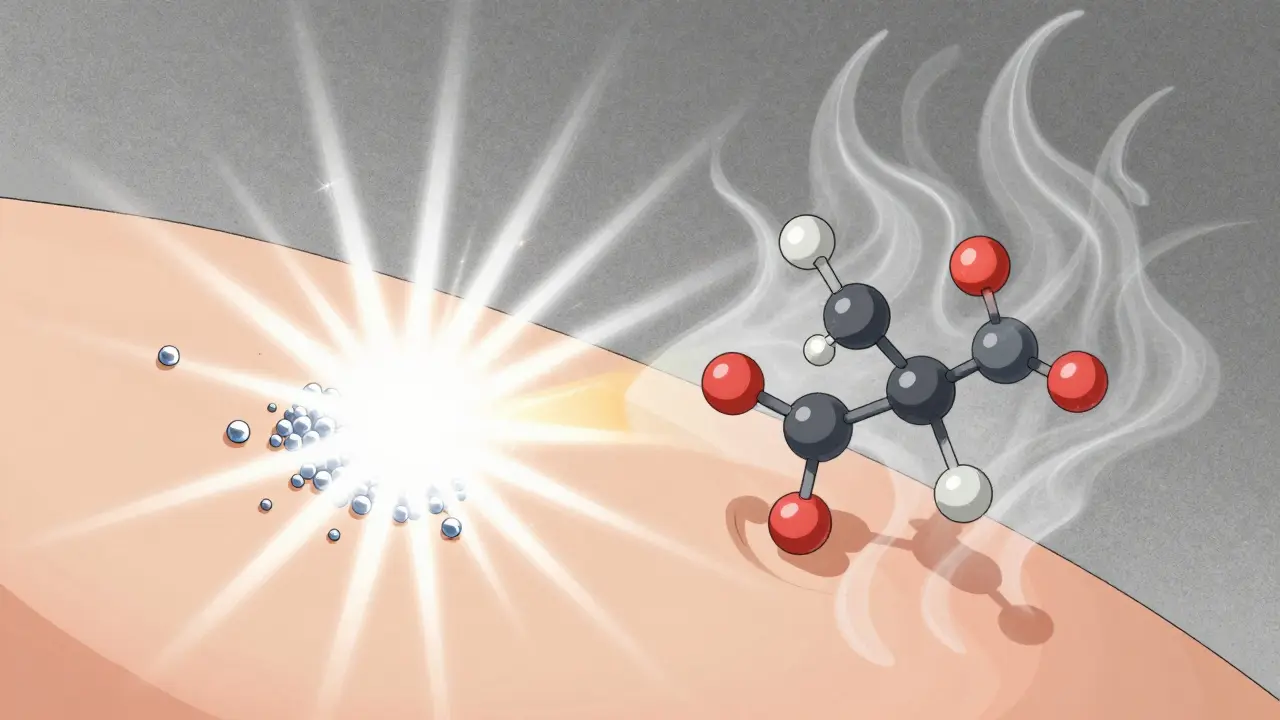
Chemical Sunscreens contain organic compounds such as Avobenzone, Octinoxate, Oxybenzone, and Octocrylene. Instead of reflecting light, these ingredients absorb UV radiation. They convert the UV energy into heat, which is then released from the skin.
Which one should you choose? It depends on your skin type and lifestyle.
- For Sensitive Skin: Mineral sunscreens are often better tolerated. A survey of over 1,200 skincare users showed that 78% reported fewer reactions with mineral options compared to chemical ones. However, mineral sunscreens can leave a white cast, especially on darker skin tones, and may feel heavier.
- For Everyday Wear: Chemical sunscreens tend to be more cosmetically elegant. They absorb quickly, leave no residue, and are easier to wear under makeup. However, some ingredients like oxybenzone can cause stinging eyes or breakouts in acne-prone individuals.
Recent regulatory shifts are influencing this choice too. The FDA has proposed limiting maximum SPF labeling to 'SPF 60+' due to diminishing returns. Additionally, concerns about coral reef health have driven demand for "reef-safe" formulations that avoid oxybenzone and octinoxate, pushing many consumers toward mineral-based options.
Daily Protection Habits That Actually Work
Buying the right sunscreen is only half the battle. How you use it determines its effectiveness. Most people fail here.
Amount Matters: Dermatologists recommend using approximately 1/4 teaspoon for your face alone. For your entire body, you need about a shot glass worth. Applying less drastically reduces your SPF. As mentioned earlier, applying half the recommended amount of SPF 30 drops your protection to roughly SPF 7.5.
Timing and Layering: Apply sunscreen as the final step in your skincare routine, after moisturizer but before makeup. Allow it 15 minutes to absorb and form a film on the skin. If you rush this, the sunscreen may pill or rub off easily.
Reapplication: Sunscreen degrades over time and wears off with sweat, friction, and water. Reapply every two hours if you are outdoors. If you are indoors near windows, once in the morning is usually sufficient unless you are exposed to direct sunlight for extended periods.
Water Resistance: No sunscreen is truly "waterproof." Labels will say "water resistant" for either 40 or 80 minutes. After swimming or heavy sweating, you must reapply immediately, regardless of the two-hour rule.
Common Myths Debunked
Misinformation about sun protection is rampant. Let's clear up three major myths.
Myth 1: I don't need sunscreen on cloudy days.
Fact: Up to 80% of UV rays can penetrate clouds. UVA rays, in particular, pass through cloud cover easily. If you can see shadows, you need protection.
Myth 2: Darker skin doesn't need sunscreen.
Fact: While melanin provides some natural protection against UVB, it does not fully protect against UVA-induced aging or skin cancer. People with darker skin tones can still develop melanoma, often later in diagnosis because it is overlooked.
Myth 3: Tanning beds are safe if used sparingly.
Fact: Tanning beds emit intense UVA radiation, which accelerates aging and increases skin cancer risk significantly. The World Health Organization classifies tanning beds as carcinogenic.
Looking Ahead: The Future of Sun Care
Sunscreen science is evolving. The global sunscreen market is projected to reach $16.89 billion by 2030, driven by increased awareness of skin health. New regulations require clearer labeling of broad-spectrum status. Researchers are also looking beyond UV rays. Emerging studies suggest that blue light from screens and infrared radiation may contribute to skin damage, leading to multi-spectrum protection becoming a standard within the next five years.
For now, stick to the basics. Use a broad-spectrum SPF 30+ daily. Reapply when needed. Protect your skin from the inside out by understanding what you are putting on it.
What is the difference between SPF 30 and SPF 50?
SPF 30 blocks 96.7% of UVB rays, while SPF 50 blocks 98%. The difference is only 1.3% in protection. However, SPF 50 offers a larger safety margin if you underapply the product, which is common among most users.
Do I need sunscreen if I am indoors?
Yes, if you are near windows. UVA rays can penetrate glass and cause long-term skin aging and damage. While UVB rays are mostly blocked by glass, UVA exposure continues throughout the day indoors.
Is mineral or chemical sunscreen better?
It depends on your needs. Mineral sunscreens (zinc oxide/titanium dioxide) are better for sensitive skin and immediate protection but may leave a white cast. Chemical sunscreens absorb into the skin, offer a lighter texture, and are often more cosmetically elegant but may irritate some skin types.
How much sunscreen should I apply to my face?
You should apply about 1/4 teaspoon of sunscreen to your face and neck. Most people apply far less, which significantly reduces the effective SPF level. Ensure even coverage across all exposed areas.
What does "broad spectrum" mean?
Broad spectrum means the sunscreen protects against both UVA (aging) and UVB (burning) rays. Look for this label to ensure comprehensive protection. In the US, broad-spectrum products must pass specific critical wavelength tests to verify UVA coverage.
You might like