
Naps and Performance: Strategic Napping for Shift Workers


The Reality of Working Against Your Body
Shift work isn't just tiring; it fights against your biology. When you work nights, your circadian rhythm gets confused, leaving you fighting a losing battle against natural sleep cycles. About 15-20% of the global workforce deals with this every day, especially in healthcare, transport, and emergency services. You aren't alone in feeling that heavy-headedness at 3:00 AM. The question isn't whether you should rest, but how to do it without wrecking your schedule or waking up more groggy than before.
This is where Strategic Napping comes in. This isn't about crashing on a couch whenever you feel tired. It's a calculated intervention designed to reset alertness right when your body tries to shut down. Evidence shows that a correctly timed nap can cut sleepiness significantly and prevent dangerous mistakes on the job.
Why Your Brain Needs a Reset Button
Your brain operates like a machine with fuel levels. During a standard night shift, that fuel burns out between the hours of 1:00 AM and 4:00 AM. This is known as the "circadian trough." If you try to push through without support, your reaction times drop and cognitive errors spike. Strategic napping acts as a rapid refueling station.
Research from Yale University highlights that this approach reduces performance deficits better than caffeine alone. A study by Caldwell et al. (2009) found that combining naps with coffee gave a 32% improvement in attention compared to caffeine by itself. Physiologically, napping lowers cortisol levels by roughly 22%. This stress hormone drops, allowing your mind to focus on tasks rather than survival mode.
| Method | Effectiveness | Time to Work | Side Effects |
|---|---|---|---|
| Strategic Napping | High (34% improvement) | Immediate (post-wake) | Sleep inertia (if too long) |
| Caffeine Only | Moderate | 30-45 minutes | Jitters, crash later |
| Light Therapy | Moderate | 3-5 days | Requires consistency |
The Perfect Nap Formula
Napping seems easy until you wake up feeling worse. That grogginess has a name: Sleep Inertia. It happens when you interrupt deep sleep. To avoid this, you need to treat napping like a science experiment with strict variables.
- Duration: Aim for 20 to 30 minutes. Anything longer increases the risk of hitting slow-wave sleep, which causes heavy grogginess upon waking.
- Timing: The sweet spot is between 2:00 AM and 4:00 AM during a night shift. This aligns with your lowest energy point.
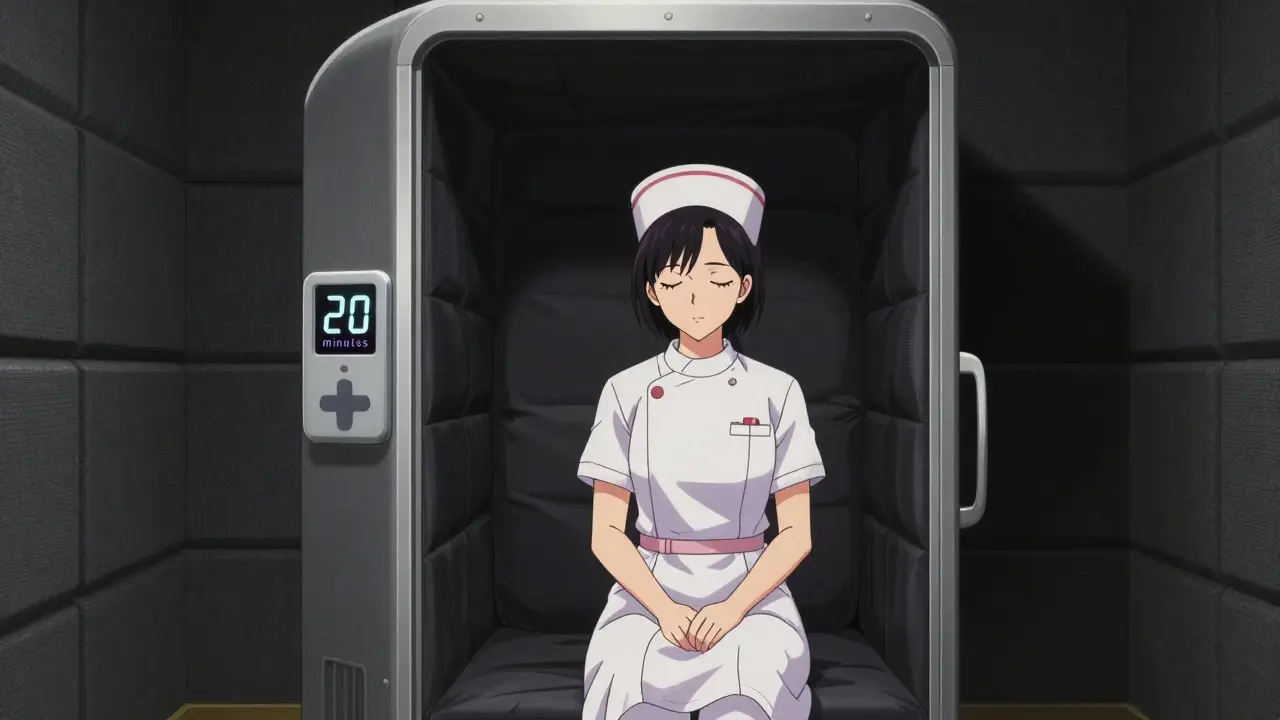
- Environment: You need darkness and quiet. CDC studies show that dedicated nap rooms reduce sleep onset time by 37% compared to regular break areas.
If you take a 45-minute nap thinking you'll get more rest, you likely won't. Deep sleep takes about 30 minutes to initiate. Waking up then leaves you disoriented. Dr. Mark Rosekind, former NASA scientist, noted that a 26-minute nap can improve performance by 34% and alertness by 54%. Precision matters here.
Setting Up a Napping Program
For individuals, finding a corner is enough. For organizations, setting up a proper protocol requires planning. Successful programs usually take 3-6 months to fully launch. This isn't just about buying a mattress; it involves culture change.
Hospitals often lead the way because patient safety relies on nurse alertness. The Joint Commission issued recommendations in 2011 specifically addressing scheduled naps. Units with soundproofed, temperature-controlled rooms see 89% higher compliance rates than those using standard break rooms. The key is making it scheduled, not optional. When staff know a nap block is part of the roster, they don't feel guilty taking it.
Training staff is also vital. Employees need to understand sleep physiology-why their body feels sleepy at certain times and why a short nap helps rather than hurts productivity. Monitoring progress using tools like the Karolinska Sleepiness Scale allows teams to track if the intervention actually works. A good target is reducing the drowsiness score by at least two points after the break.
Overcoming Barriers and Stigma
Even with great data, implementation struggles. The biggest hurdle isn't lack of evidence; it's staffing shortages. Many managers worry that a nap means someone isn't working. However, the math doesn't add up. One study showed that implementing napping programs returns $2.30 for every $1 spent due to reduced errors and accidents.
There is also a cultural stigma. Surveys indicate 67% of night-shift nurses feel judged for napping. They might fear looking lazy or incompetent. Overcoming this means leadership needs to champion the practice openly. When senior staff participate, the fear diminishes. Real-world reports from 2023 Reddit nursing communities suggest that units allowing power naps saw medication errors drop by 37% within six months.
Sector Differences and Future Trends
Not all industries move at the same speed. Aviation has been ahead of the curve for decades, with 92% of major airlines having formal policies. Flight crews use "controlled rest" protocols to manage long-haul fatigue. Healthcare is catching up, currently around 28% adoption in the US. Emergency services lag behind but are seeing shifts, particularly regarding driving safety.
The future looks bright for widespread adoption. With wearable technology emerging, personalized guidance on exactly when to nap is becoming reality. Pilot studies show biometric monitoring improves nap efficacy by 27%. Legally, we are moving toward mandates rather than recommendations. California's 2022 Fatigue Risk Management Act and similar drafts in other regions signal that safe napping options may soon be legal requirements for high-risk jobs.
Frequently Asked Questions
How long should a strategic nap last?
Ideally, 20 to 30 minutes is the optimal window. This duration allows you to get light sleep benefits without entering deep sleep stages that cause prolonged grogginess upon waking.
When is the best time to nap during a night shift?
The most effective time is typically between 2:00 AM and 4:00 AM. This corresponds with your body's natural circadian low point, known as the circadian trough.
Can caffeine replace a nap?
No, caffeine alone cannot match a nap. Studies show strategic napping combined with caffeine provides significantly better sustained attention than caffeine by itself.
What is sleep inertia?
Sleep inertia is the grogginess you feel immediately after waking. It happens if you wake up from deep sleep. Keeping naps under 30 minutes minimizes this effect.
Is there any financial benefit to napping programs?
Yes. Economic analysis suggests a return of $2.30 for every $1 invested, largely due to reductions in workplace errors and accident-related costs.
You might like

Victor Ortiz
The statistical significance here is questionable without longitudinal tracking.
emma ruth rodriguez
You bring up valid points regarding the analysis!!! However!!; The methodology seems sound.;;; We must prioritize evidence-based practices! Safety protocols are non-negotiable!
Amber Armstrong
I completely understand the exhaustion described here. It feels like a battle every single night. My sister works nights too. She used to crash at home often. Now she tries the twenty-minute trick. It actually helps her wake up sharper. People judge nappers though. They think you are slacking off. But safety is more important. We cannot afford mistakes in hospitals. Fatigue kills people quietly. You see it in the error logs. Managers need to stop being cheap. Sleep is a biological need. It isn't something we can negotiate away. I hope more places adopt this soon.
sanatan kaushik
Listen to your body. The boss does not matter. Safety is priority one. Do not let greed control you.
Rick Jackson
Biology fights us regardless of policy. We must align with nature rather than force compliance. A rest is not a weakness.
Beccy Smart
People just don't care about health anymore 😒💤. Profit always wins over safety 🏦💸. We need to shame the companies! 🚫🏢. Everyone deserves rest 🛌❤️.
Jonathan Alexander
There is a profound sadness in how tired we are allowed to become. The silence of the night amplifies the struggle.
Debbie Fradin
Management loves to talk about safety until costs rise. Then the nap rooms vanish. It is all a joke really. Workers suffer while executives feast.
Charles Rogers
Discipline is key. Many fail due to lack of self-control. If you nap properly you succeed. Poor planning leads to failure.