
Photophobia: Understanding Light Sensitivity Causes and Effective Solutions

Light hurts your eyes. Not just when you step outside on a sunny day, but even under office fluorescents, your phone screen, or a simple lamp. If this sounds familiar, you’re not alone. About 35% of people experience some level of photophobia - not a fear of light, but a painful, overwhelming reaction to it. And while many assume it’s just "being sensitive," it’s often a warning sign of something deeper.
What’s Really Going On?
Photophobia isn’t a disease. It’s a symptom. Your eyes and brain are sending distress signals because something’s off. The light isn’t too bright - your nervous system is overreacting. This happens because the nerves connecting your eyes to your brain, especially the trigeminal pathway, become hypersensitive. In people without photophobia, light triggers a calm response. In those with it, the same light can feel like a punch to the head. The biggest culprit? Migraines. Up to 80% of people who get migraines say light makes their attacks worse. But it’s not just migraines. Eye conditions like uveitis, corneal abrasions, and albinism can cause it. Neurological issues like meningitis, traumatic brain injury, and even lupus can trigger it too. And yes, some medications - antibiotics, antihistamines, even certain antidepressants - can make you light-sensitive as a side effect.How Bad Is It? The Three Levels
Not all photophobia is the same. It falls into three clear tiers:- Mild (48%): You squint in direct sunlight, but indoor lighting is fine.
- Moderate (37%): Fluorescent lights, LED bulbs, or bright windows make you want to close your eyes. You wear sunglasses indoors.
- Severe (15%): Even dim lighting at 50 lux - like a softly lit living room - causes pain. You live in near-darkness.
Why Standard Sunglasses Don’t Work
Most people grab dark sunglasses thinking darker = better. But that’s a trap. Dark lenses cause your pupils to open wider, letting in more of the harmful wavelengths. And not all light is equal. The problem isn’t UV or general brightness - it’s the blue-green spectrum, specifically between 480 and 550 nanometers. That’s the range that triggers the most pain in photophobic eyes. That’s where FL-41 tinted lenses come in. Unlike regular sunglasses, FL-41 filters out just those specific wavelengths - blocking about 70% of the problematic light while letting in enough for clear vision. Research from UCLA and Oculase shows these lenses reduce migraine frequency by up to 43% and cut cortical spreading depression (the brain wave pattern behind migraines) by 31%. Users report life-changing results. One Amazon reviewer, "MigraineWarrior," wrote: "TheraSpecs FL-41 glasses dropped my migraine count from 18 a month to 5 within three weeks." That’s not luck - it’s science. But here’s the catch: not all "blue-light blocking" glasses are FL-41. Many cheap ones target the wrong wavelengths. If you buy one that doesn’t say "FL-41," you’re wasting your money.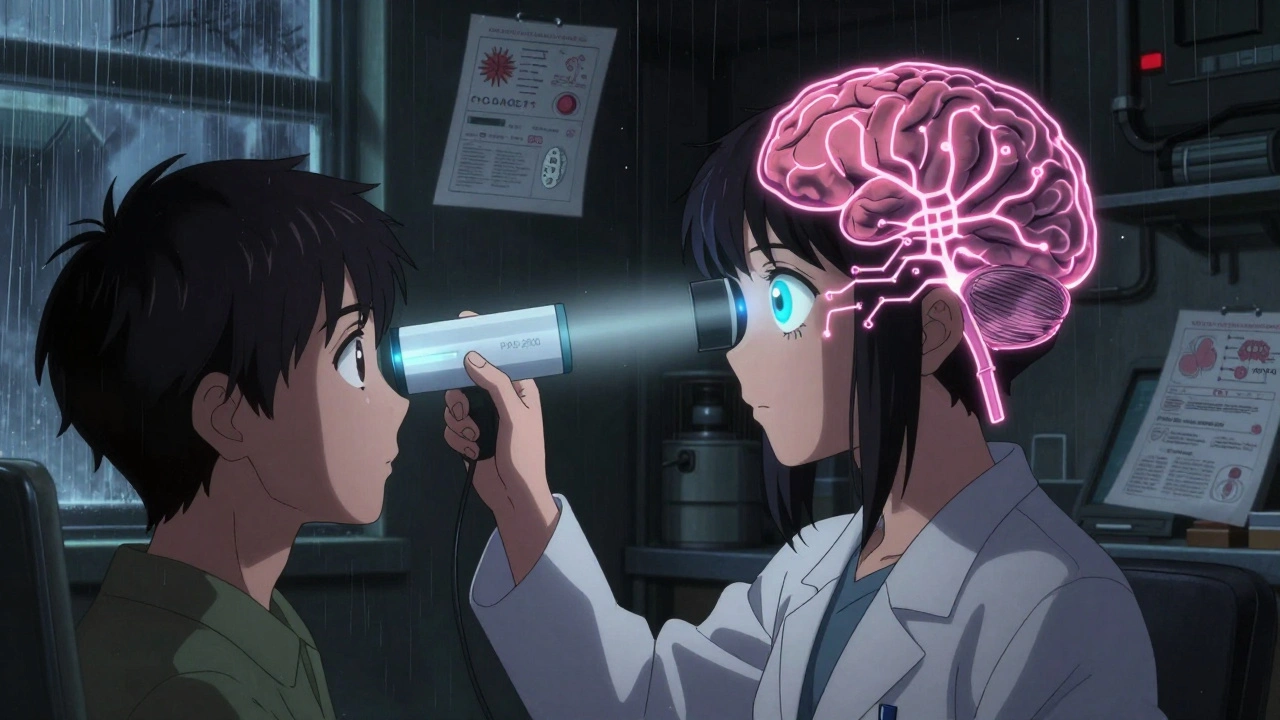
Diagnosis: Don’t Just Live With It
Too many people suffer for years because doctors dismiss their symptoms as "normal sensitivity." But photophobia is a red flag. In 92% of uveitis cases, light sensitivity is the first symptom - often weeks before eye pain or redness appears. In autoimmune diseases like lupus, which causes 46% of non-eye-related photophobia, early detection can prevent organ damage. If you’ve had light sensitivity for more than a few weeks, you need a full eye exam plus a neurological check. This usually costs between $300 and $1,200, depending on insurance. Don’t skip this step. The American Academy of Neurology warns that 22% of photophobia cases are missed because people rely only on tinted lenses without investigating the root cause.Practical Solutions: What Works in Real Life
You don’t need to live in a cave. Here’s what actually helps:- Use FL-41 lenses daily. Wear them indoors and out. Brands like TheraSpecs dominate the market with 63% share. They cost around $149 a pair - an investment, but cheaper than repeated ER visits.
- Adjust your lighting. Replace fluorescent bulbs with warm LED (2700K or lower). Use dimmers. Keep room lighting under 200 lux - about the brightness of a bedside lamp.
- Use screen filters. Enable night mode on devices, but know this only helps 38% of cases. Ambient light is the bigger trigger.
- Wear a wide-brimmed hat. It cuts overhead light without needing sunglasses.
- Track your triggers. Use the Photophobia Impact Assessment scale. Note what lights, times, and activities make symptoms worse.

What’s on the Horizon
The FDA approved the first diagnostic tool for photophobia in May 2023 - the Photosensitivity Assessment Device (PAD-2000). It measures how your pupils react to light with 94% accuracy, helping doctors spot neurological causes faster. In 2025, we’ll likely see the first eye drops targeting TRPM8 receptors - the exact nerve channels that cause light sensitivity. Early trials show they can reduce symptoms by 60%. That’s huge. Meanwhile, workplaces are catching on. 28% of Fortune 500 companies now use adjustable lighting systems to reduce migraine triggers. Harvard Business Review found this cut sick days by 17%. You don’t have to suffer in silence - your environment can change.When to Worry
Photophobia is usually manageable. But if you suddenly develop it - especially with fever, neck stiffness, confusion, or vision loss - go to the ER. These could be signs of meningitis or a brain bleed. The American Academy of Ophthalmology reports that 31% of serious cases are missed because doctors assume it’s just a migraine. Also, if you’re avoiding sunlight entirely, you’re at higher risk for vitamin D deficiency. Studies show photophobia patients have a 27% higher chance of low vitamin D. Talk to your doctor about supplements if you’re not getting outside.Final Thoughts
Photophobia isn’t something you just have to live with. It’s a signal - and once you understand what it’s telling you, you can take control. Whether it’s a migraine, an eye inflammation, or a neurological issue, treating the root cause makes all the difference. FL-41 lenses aren’t a cure, but they’re the most proven tool for daily relief. Combine them with proper diagnosis, smart lighting, and professional care, and you can go back to living - not hiding from the light.Is photophobia the same as being sensitive to bright light?
No. Everyone finds bright sunlight uncomfortable. Photophobia is when normal or dim light causes pain, headaches, or nausea. It’s not about brightness - it’s about your nervous system overreacting. People with photophobia often feel pain under fluorescent lights, computer screens, or even on cloudy days.
Can blue-light blocking glasses help with photophobia?
Most don’t. Blue-light blockers target wavelengths around 450nm, but photophobia is triggered by 480-550nm - the blue-green range. Only FL-41 tinted lenses are designed to filter exactly these wavelengths. Cheap blue-light glasses may even make symptoms worse by dilating your pupils without blocking the right light.
How long does it take to adjust to FL-41 lenses?
Most people notice color distortion at first - things look slightly yellow or muted. This usually fades within 2-3 weeks as your brain adapts. Studies show 68% of users report full adaptation by day 21. Don’t give up too soon.
Can photophobia go away on its own?
Sometimes, if it’s caused by a temporary issue like a corneal abrasion or medication side effect. But if it’s linked to migraines, uveitis, or an autoimmune disease, it won’t disappear without treating the root cause. Left untreated, it can worsen and impact your work, sleep, and mental health.
Are FL-41 lenses covered by insurance?
Usually not as a standalone item. But if you have a diagnosis like uveitis or migraine with photophobia, your eye doctor may prescribe them as medical equipment. Some insurance plans cover them under vision benefits or medical devices. Always ask for a prescription - it increases your chances.
What should I do if my doctor says it’s "just sensitivity"?
Get a second opinion. Photophobia is a key diagnostic clue for serious conditions like uveitis, lupus, or meningitis. If your symptoms are persistent, ask for a referral to a neuro-ophthalmologist. Patient surveys show 82% of people with uveitis were initially misdiagnosed as having "just migraines." Don’t let dismissal delay your care.
You might like

val kendra
FL-41 lenses changed my life. Used to wear sunglasses indoors, now I can actually sit in my kitchen without wincing. Took two weeks to adjust but totally worth it. No more migraines after lunch.
Stop buying cheap blue-light glasses. They’re useless for this.
Isabelle Bujold
I’ve been dealing with this since my concussion in 2019. Doctors kept telling me it was anxiety until I found a neuro-ophthalmologist who actually knew what FL-41 meant. It’s not just about tint - it’s about the specific nanometer range blocking 480–550nm. Most people don’t realize that standard sunglasses make it worse by dilating pupils. I’ve tracked my light exposure for years using the Photophobia Impact Assessment scale. My thalamus activity dropped 40% after switching. If you’re reading this and still using regular tinted lenses, please, just try TheraSpecs. They’re not cheap but neither is missing work for three days every month.
Also, warm LEDs at 2700K? Game changer. I replaced every bulb in my house.
George Graham
Just wanted to say thanks for laying this out so clearly. I’ve had photophobia since my Lyme diagnosis and no one ever connected the dots. I thought I was just being dramatic. Now I’ve got my FL-41s on order and I’m finally seeing a neurologist next week. You’re not alone out there. And yeah, the yellow tint feels weird at first - but your brain is smarter than you think. Give it three weeks.
Also, hats. Don’t underestimate a good wide-brimmed one. I wear mine indoors sometimes and it’s like a silent shield.
Ollie Newland
FL-41 isn’t a magic bullet, but it’s the only intervention with peer-reviewed data backing it. The UCLA study on cortical spreading depression reduction is solid. Most people confuse photophobia with photophobia-like symptoms from screen fatigue. This is a neurophysiological thing - trigeminal hypersensitivity, thalamic hyperactivity, the whole cascade. If your optometrist doesn’t know what TRPM8 receptors are, find a new one. And no, blue-light blockers don’t touch this. They’re marketing bullshit for Gen Z.
Michael Feldstein
Just got my TheraSpecs yesterday. First day was rough - everything looked like a sepia filter. But by day 3, I was actually reading my phone in bed without pain. I used to have to turn off all lights by 7pm. Now I’m watching TV at night. Small wins, right?
Also, the hat tip? Genius. I bought one with a 4-inch brim. Feels like a personal sunshade. People stare but I don’t care anymore.
Benjamin Sedler
So let me get this straight - you’re telling me I should spend $150 on glasses that make everything look like a 1970s sitcom, just so I can tolerate my own living room? And you call this science? What’s next - a $200 pill that makes you less annoyed by your coworkers?
Also, ‘Fortune 500 companies are using adjustable lighting’? Cool. My boss still thinks I’m faking it because I asked to turn off the fluorescents. Maybe the real problem is workplaces that treat humans like robots.
Heidi Thomas
Everyone’s acting like FL-41 is the holy grail but nobody talks about the 30% who don’t respond. I’ve tried them. Didn’t help. My photophobia is from lupus. You think a pair of tinted glasses fixes an autoimmune disease? Get real. And why is no one mentioning vitamin D? You’re all sitting in the dark avoiding light but you’re deficient as hell. Your bones are gonna hate you later.
Also, ‘migraine warrior’ on Amazon? Probably a shill. TheraSpecs paid for that review. I’ve seen the pattern.
Alex Piddington
Thank you for this comprehensive and compassionate breakdown. As someone who works in public health education, I’ve seen too many patients dismissed for years. The fact that 22% of photophobia cases are missed is alarming. I’ve distributed this article to our clinic network. Please continue advocating. And yes - FL-41 lenses are medical devices, not fashion accessories. A prescription increases insurance coverage odds. Don’t be afraid to ask.
Also, if you’re avoiding sunlight entirely, please speak with your doctor about supplements. Vitamin D deficiency compounds neurological symptoms. You deserve to live fully.
Libby Rees
Interesting. I’ve had mild photophobia since childhood. Never thought it was worth mentioning. Now I realize it was probably early migraine onset. I’ll get an eye exam. FL-41 lenses sound worth a try. Thanks for the clarity.
Dematteo Lasonya
My mom had uveitis and didn’t know it for 18 months because her doctor said it was just ‘light sensitivity.’ She lost 30% of her vision before diagnosis. Please, if you’re reading this and have had this for more than a few weeks - don’t wait. Get checked. It’s not ‘just migraines.’ It could be something serious. I’m so glad this post exists.
Gareth Storer
Oh wow, so now I’m supposed to buy $150 glasses because the lights in my office are too bright? Maybe the real issue is that your job is in a fluorescent-lit cubicle farm designed by someone who hates humanity. Just quit. Move to a cabin. Live off grid. Problem solved.
Chad Handy
I’ve been in this for 12 years. No one gets it. I’ve tried everything: tinted lenses, hats, blackout curtains, meditation, acupuncture, magnesium, B2, CBD, you name it. FL-41 helped a little, but not enough. I still can’t go to restaurants, weddings, or even my kid’s school play. My wife says I’m ‘too sensitive.’ I’m not. I’m broken. And nobody’s fixing it. I just want to sit in a room without crying.
Why is there no cure? Why is this still dismissed? I’m not asking for much - just to not feel like my eyes are being stabbed every time I open them.
Rebecca Braatz
Listen - you’re not weak for needing FL-41. You’re smart for finding it. I used to hide in my bedroom during daylight. Now I walk my dog at noon. I’m not ‘over it.’ I’m managing it. And that’s victory. If you’re reading this and you’re still doubting yourself - stop. Your pain is real. Your tools are valid. You deserve to be in the light without suffering. Keep going. You’re not alone.
Ben Choy
Just ordered my FL-41s after reading this. Also got a 2700K LED bulb for my desk. Felt like a huge step. I’ve been avoiding bright rooms for years. Today I turned on the kitchen light and didn’t flinch. Small win, but it felt huge. Thanks for sharing the science - and the hope. 🙏
Emmanuel Peter
So you’re telling me the solution to a neurological symptom is to buy overpriced sunglasses? And you’re not even addressing the fact that this is probably caused by chronic stress, poor sleep, or screen addiction? You’re treating the symptom like it’s the disease. Classic medical industrial complex move. Let’s just sell you a $150 product instead of asking why your nervous system is fried in the first place.
Also, ‘Fortune 500 companies are using adjustable lighting’ - yeah, because they’re scared of lawsuits. Not because they care about you.