
Traveling with Controlled Medications: A Guide to Customs and Doctor's Letters

Medication Travel Readiness Checklist
Use this tool to verify your preparation based on global customs guidelines. Check off the items you have completed to see your readiness score.
Readiness Status
Imagine landing in a foreign country after a ten-hour flight, only to have a customs officer pull you aside and confiscate your essential medication because you're missing a single piece of paper. It happens more often than you'd think. In fact, data from the CDC's 2024 Yellow Book shows that about 23% of travelers face medication confiscation when they don't have the right documentation for controlled substances. Whether you're managing ADHD with Adderall, treating chronic pain with oxycodone, or using diazepam for anxiety, the difference between a smooth breeze through customs and a legal nightmare is a well-drafted travel letters for controlled medications.
The goal here isn't just to follow rules; it's to protect your health and your freedom. Crossing borders with controlled substances without the correct paperwork can lead to travel delays, denial of entry, or even arrest. But if you spend a few weeks preparing, you can reduce your risk of border complications by nearly 90%. Let's break down exactly how to handle your meds so you can focus on your trip, not a courtroom.
What Exactly is a Medication Travel Letter?
A travel letter is a formal document from your healthcare provider that verifies you have a legitimate medical need for a specific drug. It's not just a note saying "my patient needs this"; it's a detailed medical justification. The International Narcotics Control Board (INCB) is the independent monitoring body that sets the global guidelines for how narcotic and psychotropic substances are regulated across borders. They emphasize that while small amounts for personal use are generally okay, every country has its own unique set of rules.
For most travelers, this letter serves as the bridge between your personal health needs and the strict laws enforced by agencies like the U.S. Food and Drug Administration (FDA), which regulates the import of prescription drugs into the United States to ensure they are for personal use and not commercial distribution . If your paperwork is incomplete, you're playing a risky game of chance with customs agents.
Essential Elements Your Doctor Must Include
A vague letter is almost as bad as no letter. According to the CDC, 78% of medication confiscations happen because the documentation was missing key details. To avoid being the "suspicious" traveler, ensure your physician includes these specific points:
- Your Full Name: This must match your passport exactly. No nicknames.
- Medication Details: Both the brand name and the generic name (e.g., "Adderall / Amphetamine-dextroamphetamine").
- Dosage and Strength: The exact milligrams and how many times a day you take it.
- Medical Indication: A brief explanation of why you need the medication (e.g., "treatment for chronic neuropathic pain").
- Physician's Credentials: Their contact information and medical license number.
- Trip Duration: A statement that the amount of medication you're carrying is intended for the duration of your stay.
If you are heading to a non-English speaking country, don't assume the agent will understand your letter. Many travelers find they need certified translations. While these can cost between $25 and $75, they are a small price to pay compared to spending two hours in a detention room.
Navigating Country-Specific Red Flags
One size does not fit all when it comes to global drug laws. A medication that is perfectly legal in New Zealand or the US might be strictly forbidden elsewhere. For example, Zolpidem is a sedative-hypnotic medication used to treat insomnia , but it is completely prohibited in the United Arab Emirates and Japan.
| Country | General Rule | Special Requirement |
|---|---|---|
| United States | Up to 90-day supply allowed | Physician letter & prescription copy |
| Japan | Very strict on stimulants/sedatives | Yakkan Shoumei (Import Certificate) |
| United Kingdom | Up to 3 months' supply | Controlled Drug Import Certificate for narcotics |
| Australia | Strict control on Schedule 8 drugs | TGA prior approval for certain substances |
If you're traveling to Japan, a standard doctor's letter isn't enough for many controlled substances. You'll need a Yakkan Shoumei, which is an official import certificate issued by the Japanese government for medications and medical equipment. This process takes about 7 to 10 business days and usually costs around $50. Ignoring this step is why 42% of American travelers to Japan report medication-related issues.
The Logistics: Packaging and Packing
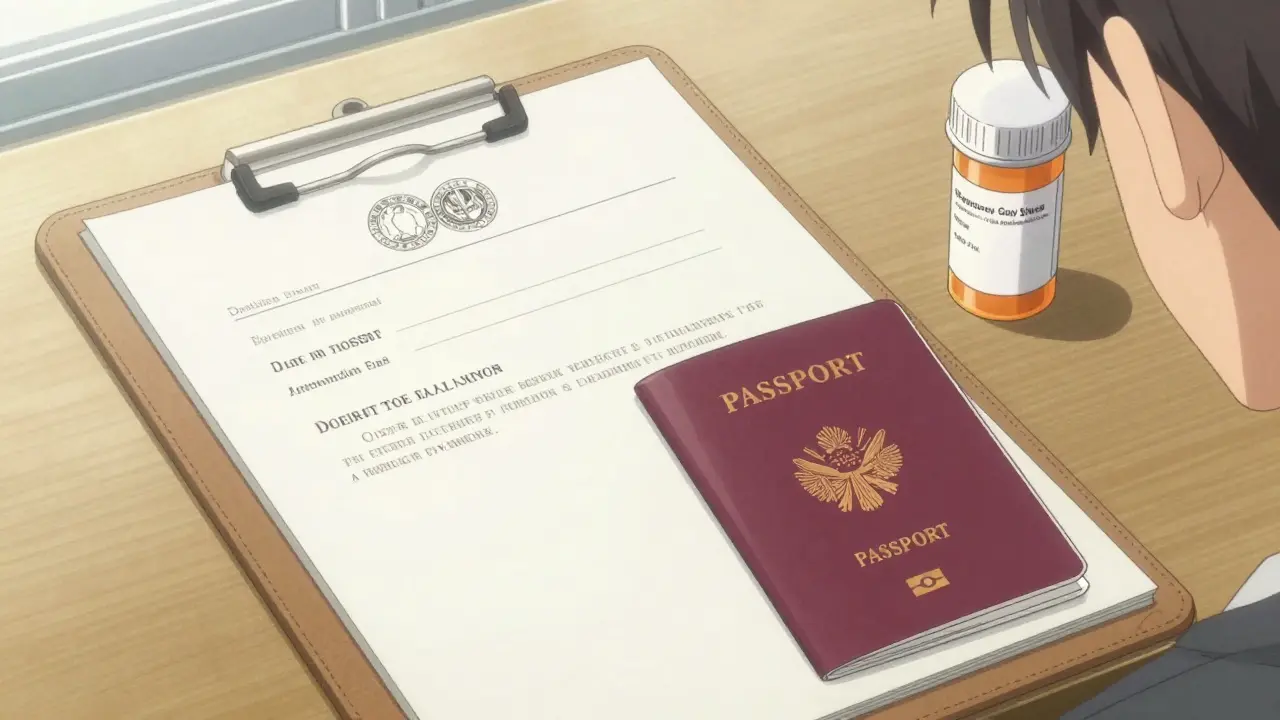
How you carry your meds is just as important as the paperwork. One of the biggest mistakes travelers make is moving their pills into a generic plastic organizer to save space. While convenient, this is a red flag for customs. Over half of all medication issues at U.S. customs stem from repackaged drugs. Agents can't verify the substance, the dosage, or the patient name if it's not in the original bottle.
Keep your medications in their original pharmacy containers with the labels intact. If you have a massive supply that won't fit in a carry-on, don't check them in your luggage. Luggage gets lost; your health shouldn't be. Keep your meds and your documentation in your carry-on, easily accessible. If an agent asks to see them, you can hand over the original bottle and the doctor's letter in seconds. According to the FDA, 92% of properly documented personal medication imports are approved within 15 minutes of inspection.
Step-by-Step Timeline for Preparation
Don't leave your paperwork for the night before your flight. Getting these documents signed and translated takes time. Follow this timeline to ensure you're covered:
- 6 Weeks Before: Research your destination's specific drug laws. Check if your medication is banned or requires a special permit like the Yakkan Shoumei.
- 4 Weeks Before: Schedule an appointment with your doctor. Provide them with the list of required elements for the travel letter so they don't have to rewrite it.
- 3 Weeks Before: Get your prescriptions translated if necessary. Ensure you have digital copies of everything saved on a cloud drive and physical copies in your travel folder.
- 2 Weeks Before: Confirm you have enough medication for the trip plus a small buffer (without exceeding the legal 90-day limit for the US).
- Departure Day: Pack medications in original containers in your carry-on with the letter and a copy of your passport.

Dealing with Airport Security and Customs
When you reach the customs declaration point, honesty is your best policy. If you are carrying controlled substances, it is always better to declare them than to have them found during a random bag search. A declared medication with a letter is a medical necessity; an undeclared medication found in a bag looks like smuggling.
If you get pulled aside, stay calm. Present your documents clearly. If the agent has questions, refer them to the doctor's contact information in your letter. In the rare event that your paperwork is questioned, having a digital copy of your prescription that you can email to the agent can save you hours of stress. Remember, agents are looking for commercial distribution-meaning they want to make sure you aren't selling the drugs. Keeping your supply within a reasonable personal limit (typically under 50 dosage units for Schedule II drugs unless you have a heavy prescription) helps prove you're just a patient, not a dealer.
What happens if my medication is confiscated at the airport?
If customs seizes your medication, immediately ask for a formal seizure notice and the contact information for the supervising officer. Do not sign any documents admitting to a crime if you have a legal prescription. Contact your embassy or consulate immediately. They can often help you find a local physician to write a temporary prescription so you don't miss doses of your medication.
Can I just use a photo of my prescription instead of a doctor's letter?
While a photo of your prescription helps, it often isn't enough. A prescription proves you bought the drug; a doctor's letter proves why you need it and that your doctor supports your travel with it. Many customs agents require the narrative explanation found in a letter to satisfy legal requirements for controlled substances.
How many pills am I allowed to carry without special authorization?
This varies wildly by country. In the US, the DEA generally looks for prescriptions issued by a registered practitioner if you have more than 50 dosage units of controlled substances. However, some countries have zero-tolerance policies for certain stimulants or sedatives regardless of the amount. Always check the specific laws of your destination country.
Do I need a letter for over-the-counter meds like pseudoephedrine?
Yes, in some regions. While pseudoephedrine is a common decongestant, it's a precursor for illegal drugs and is strictly regulated in countries like Mexico or Japan. If you're carrying large amounts of it, a simple note or the original packaging is highly recommended to avoid suspicion.
Should I carry my medications in a pill organizer to save space?
It's strongly advised against. About 53% of medication issues at U.S. customs are caused by repackaged medications. To avoid delays, keep your meds in the original pharmacy-labeled containers. If you must use an organizer, carry the original empty bottles alongside it for verification.
What to Do If Things Go Wrong
Despite your best efforts, you might still run into a hurdle. If a customs agent is hesitant, don't get defensive. Instead, offer to call your doctor right there on the spot. In one documented case at JFK airport, a traveler was detained for nearly an hour because they had a prescription but no doctor's letter; the situation was resolved quickly once the physician faxed a letter explaining the medical condition.
If you are traveling to a high-risk region and are worried about your meds, consider using a travel medicine specialist. These pros can provide a more comprehensive "medical passport" that lists everything in the local language and provides a higher level of authority than a standard GP's note. For those with chronic conditions, the resolution time for border issues drops from two hours to about 28 minutes when proper documentation is readily available. Be the traveler who is ready for anything.
You might like
Ben hogan
Imagine actually thinking that a list of basic common sense tips is 'groundbreaking' content. It's essentially just a glorified set of instructions for people who lack the basic intellect to read a government website. Truly pedestrian.
Emily Wheeler
I absolutely love how comprehensive this guide is because I've always felt that the intersection of personal health and international law is just so fascinatingly complex, and it really encourages us to be proactive about our well-being while we explore the vast beauty of the world. It's almost like the act of preparing these documents becomes a ritual of care for oneself, ensuring that the journey is not marred by avoidable bureaucratic friction, which in turn allows the spirit to remain open and energetic for the actual adventure awaiting us across the ocean.
Simon Stockdale
I dont see why we gotta jump thru so many hoops just to carry our own meds when some of these countries dont even have half the medikal advancements we got in the US and its honestly a joke how much power some customs agent has to ruin a whole vacation just cuz they dont like how a letter is writtn!
Kelly DeVries
omg the part about the pill organizers is so real i did that once and the agent looked at me like i was selling candy on the street lol so embarrassing
Suchita Jain
It is imperative that individuals exercise the utmost diligence in these matters. One must realize that ignorance of local statutes is never an acceptable excuse when facing the judiciary of a foreign sovereign nation.
Chad Miller
ppl really just dont care about the laws anymore... its basic respnsibility to have a letter if your carring drugs into another country honestly
Julie Bella
Ugh!! I tried to do this for my trip to Mexico last year and my doctor was such a pain about it!! Like hello?? Just write the letter!!! 🙄 some people have no idea how to be helpful in a crisis!!
Thabo Leshoro
The pharmacokinetics of these substances mean that missing a dose is not an option... absolutely not!!! Proper documentation is the only way to avoid a total crisis... definitely!!!
emmanuel okafor
every country has its own way of seeing things so its best to just follow the rules and keep the peace
Lynn Bowen
The tip about the Yakkan Shoumei for Japan is a lifesaver. I've seen so many tourists get blindsided by that specific requirement because they thought a general doctor's note was enough.