
Future Legal Developments: Key Proposed Laws and Regulatory Changes in 2025-2026

By early 2026, the legal landscape in the U.S. has shifted more dramatically than in any recent decade. It’s not just about new laws-it’s about how those laws reshape daily life for workers, businesses, homeowners, and even people behind bars. If you’re running a company, managing payroll, or just trying to understand your rights, you can’t afford to ignore what’s changed-or what’s coming next.
What’s Actually Changing in 2025-2026?
Over 4,800 new regulations were published in 2024 alone. That’s not a typo. And by mid-2025, state-level changes jumped more than 13% compared to the year before. This isn’t random noise. It’s a pattern: while the federal government pulls back in some areas, states are stepping in with stricter rules. The result? A patchwork of laws that make compliance harder than ever.
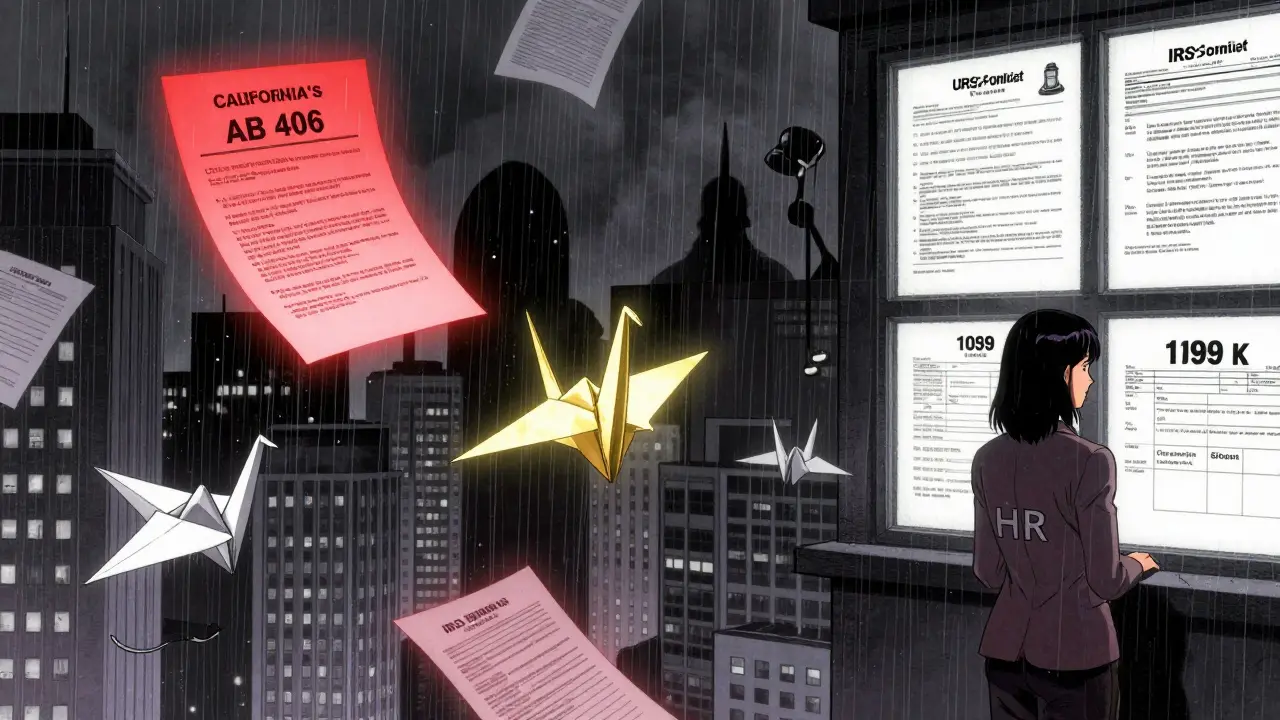
Take California. In October 2025, Assembly Bill 406 went into effect, merging three separate leave laws into one. Now, employees who are victims of domestic violence, stalking, or sexual assault can take paid time off without jumping through hoops. Employers had to update their handbooks, train managers, and revise their HR systems-all within weeks. The Civil Rights Department even released a new Survivors of Violence and Family Members of Victims Right to Leave and Accommodations notice template. Missing that update? You could be fined.
Pay, Leave, and Workplace Rules Are Getting Tighter
California’s Senate Bill 642 changed pay transparency rules. Now, employers must list salary ranges in all job postings-even for remote roles if the employee might work in-state. That means small businesses in Texas hiring a remote worker in San Francisco suddenly need to comply with California law. It’s not about where the office is. It’s about where the person lives.
Then there’s paid sick leave. AB 406 also updated Labor Code section 246.5, expanding how employees can use sick time. You can now take it to care for a close friend or partner-not just family by blood. The law calls them a “designated person.” No paperwork needed. Just a verbal confirmation. But HR departments had to rewrite policies, update payroll software, and retrain managers who used to think “family” meant parents, kids, or spouses.
And don’t forget Paid Family Leave. Senate Bill 590 expands eligibility to include those caring for a designated person-but it doesn’t kick in until July 1, 2028. That’s not a typo. The state gave businesses three years to prepare. Many didn’t. Now, in early 2026, companies are scrambling to adjust their leave tracking systems before the deadline.
The Federal Government Is Pulling Back-But That Doesn’t Make Things Easier
At the federal level, things are moving in the opposite direction. The One, Big, Beautiful Bill (Public Law 119-21), signed on July 4, 2025, rolled back reporting rules for gig workers. The IRS went back to requiring Form 1099-K only for transactions over $20,000 (down from $600). That’s good news for freelancers. But it’s bad news for accountants. Now, instead of tracking millions of small payments, they have to audit the big ones more carefully. The IRS released two new fact sheets (FS-2025-07 and FS-2025-08) just to clarify the change.
There’s also a new $6,000 tax deduction for people 65 and older. Sounds simple, right? But the IRS had to update 12 forms, rewrite instructions for tax software, and train thousands of volunteers at AARP tax clinics. The change applies to tax years 2025 through 2028. That means if you’re filing your 2026 return in early 2027, you need to know this rule exists.
And then there’s the LEOSA Reform Act of 2025. This federal law lets qualified retired police officers carry concealed guns in more places-school zones, national parks, even some federal buildings. States can now lower the training frequency required for retired officers. But here’s the catch: not every state accepts it. Some, like New York and California, have their own stricter rules. So a retired officer from Arizona moving to San Diego? They might lose their right to carry unless they requalify under California law.

Housing Is Being Rewritten-Fast
California’s housing crisis got a major legislative push in mid-2025. Assembly Bill 130 and Senate Bill 131 created sweeping exemptions to the California Environmental Quality Act (CEQA). For decades, CEQA allowed neighbors to delay or block housing projects with lawsuits. Now, for qualifying projects-especially affordable or transit-oriented housing-those delays are gone. Developers can skip full environmental reviews if they meet certain criteria.
The result? The California Building Industry Association says approval times for qualifying projects are now 18 to 24 months shorter. That’s huge. In 2024, the average new housing project took 4.5 years from permit to occupancy. Now, it’s under 3. That’s not just faster. It’s life-changing for people stuck on waiting lists.
But it’s not all smooth sailing. Environmental groups are challenging the law in court. And local governments are still figuring out how to enforce the new rules without triggering lawsuits. The state’s Department of Finance estimates housing production will rise 15-20% by 2027. But only if the courts don’t roll it back.
What the Supreme Court Is About to Do
With the 20th anniversary of the Roberts Court in 2025, the Supreme Court is taking on cases that could redefine American law. One major case looks at whether the president can unilaterally suspend federal regulations during emergencies. Another tests whether states can ban certain types of speech on social media platforms. A third could limit the power of federal agencies to write rules without explicit congressional approval.
Legal teams at Fortune 500 companies have already increased their constitutional law expertise by 25% since late 2024. Why? Because if the court sides with the president, entire departments-like the EPA, FDA, or SEC-could lose their ability to enforce rules. That means companies might have to rewrite compliance manuals overnight. No warning. No transition period.

Compliance Is No Longer a Job-It’s a System
Companies used to treat compliance like an annual audit. Now, it’s a 24/7 operation. The California Chamber of Commerce calls it “a constant, enterprise-wide effort.” That means:
- HR departments need real-time alerts for new laws
- Payroll systems must auto-update based on location
- Legal teams track federal and state changes simultaneously
- Managers can’t just say “I didn’t know” anymore
Costs are rising. Employers in California report spending $1,200 to $1,800 per employee just to train staff on AB 406. Tax professionals saw a 40% jump in enrollment for 2025 update courses. And compliance software vendors are growing 35% a year.
By 2026, 78% of Fortune 500 companies will use AI tools to scan for new regulations. That’s not science fiction. It’s happening now. The alternative? Fines, lawsuits, and reputational damage.
What You Need to Do Right Now
If you’re an employer, check these three things:
- Did your HR system update for California’s victims’ leave law (AB 406)?
- Are your payroll settings set to the new $20,000 Form 1099-K threshold?
- Do your managers know how to handle a “designated person” leave request?
If you’re a freelancer or gig worker, make sure your 2025 income records reflect only payments over $20,000. Anything below that doesn’t need to be reported under the new IRS rule.
If you’re a landlord or developer in California, look into whether your project qualifies for the new CEQA exemptions. You could save over a year in approval time.
And if you’re just trying to stay informed? Bookmark the IRS website, follow your state’s labor department, and sign up for alerts from your chamber of commerce. This isn’t a one-time update. It’s the new normal.
Are federal and state laws conflicting right now?
Yes. Federal law is relaxing rules in areas like tax reporting, Medicare Advantage, and financial oversight. Meanwhile, states like California, New York, and Washington are passing stricter labor, housing, and privacy laws. This creates a legal tug-of-war. A company with offices in Texas and California must follow both sets of rules. Ignoring one can lead to fines-even if the other law is federal.
What’s the biggest change for small businesses in 2026?
The biggest change is the requirement to track employee location for labor laws. If you hire remote workers, you may now need to comply with the laws of their state-not just your headquarters. A small business in Florida with one employee working from Oregon must follow Oregon’s paid sick leave rules, minimum wage, and notice requirements. Many small employers are using automated HR platforms to handle this.
Will the new tax deduction for seniors affect my 2025 taxes?
Yes. If you’re 65 or older and filing your 2025 tax return in early 2026, you can claim a $6,000 deduction on top of your standard deduction. The IRS says it applies to individuals who turned 65 anytime in 2025. You don’t need to itemize. Just check the box on Form 1040. But make sure your tax software is updated-many older versions still use the pre-2025 rules.
How do I know if my business is affected by CEQA exemptions?
Only California businesses are affected. If you’re building or renovating housing, especially near public transit, or developing infrastructure like water or energy projects, you may qualify. The key is whether your project meets the state’s “housing-first” criteria. Check the California Governor’s Office website for the official checklist. If you’re unsure, consult a land-use attorney-waiting too long could cost you a year in delays.
What’s happening with the LEOSA Reform Act in states like California?
California has not adopted the federal LEOSA changes. Retired officers living in California must still follow the state’s stricter rules for concealed carry, including annual qualification and background checks. The federal law doesn’t override state law here. So even if you’re federally qualified, you’re not automatically allowed to carry in California. Always check state-specific rules before assuming your rights apply.
What’s Next?
More changes are coming. The IRS will release 2026 tax inflation adjustments by October 2026. Congress is still debating bills to restore phone access for detainees. States are preparing another 1,200 regulatory proposals for late 2025 and early 2026. The pace isn’t slowing. The only way to keep up is to build systems-not just rely on memory or annual reviews. The legal world isn’t waiting. Neither should you.
You might like
sagar sanadi
lol so now my 1099-K only matters if I make over $20k? 🤡 guess i'll just start charging $20,001 for every freelance gig. next they'll say you can't be taxed if you whisper your income to a squirrel. #governmentlogic
kumar kc
This is why people don't trust institutions. Every law is a trap for the small guy.
clifford hoang
They’re not changing laws… they’re programming us. 😈 The ‘designated person’? That’s Step 1. Next it’s ‘designated consciousness’ - then your thoughts get tracked. They want you to think you’re free while the algorithm decides who gets leave, who gets fined, who gets silenced. 🤖💔 #NewWorldOrder
Emily Leigh
okay but like... why does california get to be the law lab for the whole country? 🙄 i'm tired of my tiny florida biz having to hire a lawyer just to know if my remote worker in oakland can take time off to cry over their cat. it's not a workplace issue, it's a mental health crisis disguised as legislation.
Renee Stringer
I'm not against helping survivors. But when you make HR departments into legal compliance robots, you lose the humanity. People aren't data points. They're humans who need grace, not a checklist.
Shane McGriff
Look, I get the frustration with all these rules - but let’s be real: this isn’t overreach, it’s correction. For decades, workers got crushed by vague policies and power imbalances. Now we’re finally building systems that protect people who’ve been ignored. It’s messy? Yes. Necessary? Absolutely. Don’t hate the update - hate the old system that made this necessary.
Jacob Cathro
soo... the fed says no 1099-k under 20k but cali says you gotta track designated persons and ceqa exemptions and now i'm supposed to use ai to not get sued?? 🤯 my small biz has 3 people and i still use google sheets. this isn't compliance, this is a survival sim. someone please just give me a button that says 'i'm good' and let me go back to sleep.
Paul Barnes
The claim that '78% of Fortune 500 companies use AI to scan for regulations' is misleading. The actual figure, per Gartner’s Q3 2025 report, is 61%. The rest use manual tracking with legal teams. Don't inflate the narrative to sell software.
pragya mishra
Wait, so if I'm a woman working remotely from India for a California company, does my 'designated person' count if I'm not married? And who decides what 'close friend' means? Are you going to audit my WhatsApp chats now? 😒
Manoj Kumar Billigunta
I’ve seen this happen in my own community. A guy lost his job because his HR system didn’t update the 'designated person' rule. He didn’t even know he could take time off for his best friend who was in the hospital. That’s the real story - not the laws, not the fines. It’s people left behind by systems that move faster than compassion. We need training, not just tech. We need empathy, not just compliance.