
Hip Pain: Managing Labral Tears and Arthritis Through Activity Modification


When your hip starts hurting, it’s easy to blame aging, overuse, or a bad workout. But for many people, especially those between 30 and 50, the real issue might be something more specific: a labral tear or early hip arthritis. These aren’t just random aches-they’re structural problems that change how your hip moves, loads, and heals. And the most effective way to manage them isn’t always surgery or pills. It’s changing what you do, how you sit, and which movements you avoid.
What’s Really Going on in Your Hip?
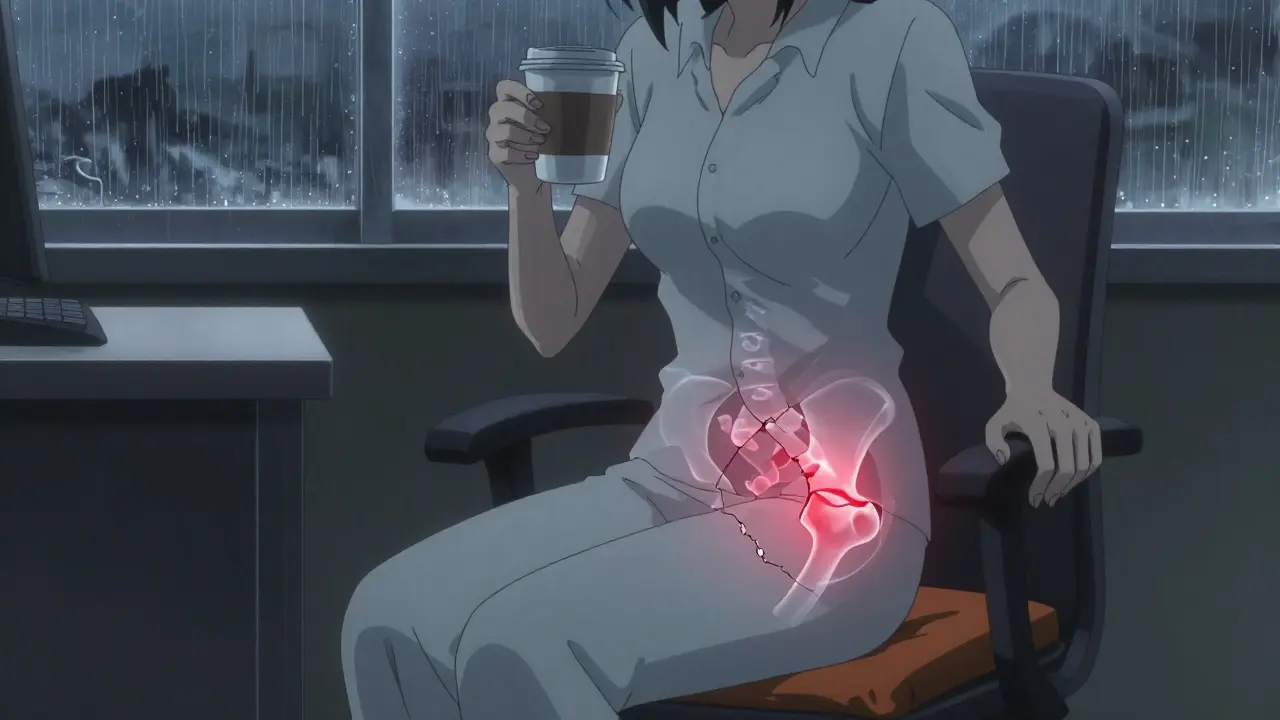
The hip joint is a ball-and-socket, but it’s not just bone on bone. Around the socket is a ring of tough cartilage called the labrum. It’s about the thickness of a credit card, but it does heavy lifting: it seals the joint, holds in lubricating fluid, and keeps the ball centered. When it tears-usually in the front of the hip-you lose that seal. Studies show this increases pressure on the joint’s main cartilage by 92%. That’s not just pain. That’s accelerated wear. At the same time, hip arthritis (osteoarthritis) is slowly breaking down that main cartilage. It doesn’t happen overnight. It starts with tiny cracks, then thinning, then bone grinding on bone. The scary part? These two problems often feed each other. A labral tear can speed up arthritis. And if arthritis is already there, even a small tear becomes more painful and harder to fix. You might hear people say, “I have a labral tear on my MRI.” But here’s the twist: 38% of people over 50 with no pain at all have labral tears on scans. That means the tear alone doesn’t cause pain. It’s what you do with your hip afterward that turns a silent tear into a disabling problem.Why Activity Modification Isn’t Just “Rest”
Most people think “modify your activity” means stop exercising. That’s wrong. It means change how you move. Think of your hip like a door hinge. If the hinge is worn, you don’t stop opening the door-you stop slamming it. Same with your hip. Deep squats, lunges, cross-legged sitting, and twisting while bending forward? Those are the “slamming” movements. They jam the femur into the socket, especially if you have a cam-type impingement (a bony bump on the ball of the hip). That’s where most labral tears happen. The Cleveland Clinic’s 2023 guidelines say: avoid hip flexion past 90 degrees. That means no sitting in low chairs, no deep yoga poses like pigeon, and no sitting cross-legged on the floor. For desk workers, this is huge. Sitting for more than 30-45 minutes without standing? Pain spikes. The fix? Stand every 30 minutes. Use a footrest to keep knees slightly lower than hips. A simple wedge cushion in your chair can reduce hip flexion by 10-15 degrees. That’s enough to take pressure off the labrum. For sleep, place a pillow between your knees if you’re on your side. This keeps your hips aligned and prevents internal rotation, which aggravates tears. If you’re a runner, switch to swimming or the elliptical. A Reddit survey of 387 people with hip impingement found 71% could tolerate swimming without pain, but only 29% could keep running.What Movements to Avoid (And What to Do Instead)
Here’s what most people with hip labral tears or early arthritis need to rethink:- Deep squats and lunges → Replace with step-ups or glute bridges. Keep your knees behind your toes and avoid going below parallel.
- Cross-legged sitting → Use a chair with armrests. Sit with feet flat, knees at 90 degrees.
- High-impact sports → Swap tennis or basketball for cycling or water aerobics. Low-impact cardio protects the joint while keeping you strong.
- Stair descent → Go down stairs one foot at a time, leading with your stronger leg. Use the handrail. Descending stairs puts 3x your body weight through the hip.
- Twisting while bending → When picking something up, bend your knees, keep your back straight, and turn your whole body-not just your hips.
When Surgery Makes Sense-And When It Doesn’t
Surgery isn’t the first answer. In fact, for people over 60 with advanced arthritis (Kellgren-Lawrence Grade 3 or 4), surgery often doesn’t help much. The cartilage is already too gone. A 2022 study showed 45% of these patients still needed a hip replacement within five years, no matter what they did. But for younger people with a labral tear and early arthritis, especially if they have cam-type impingement (a bony bump on the femur), surgery can be life-changing. Hip arthroscopy to repair the labrum-not just trim it-has a 85-92% satisfaction rate at five years. The key? Repair, not debridement. Trimming the tear is like cutting a frayed rope. Repairing it is like sewing it back together. The difference? One preserves the joint’s seal. The other doesn’t. Cortisone shots? They help temporarily-about 3.2 months on average. But if you get more than three a year, you risk damaging the cartilage even more. Viscosupplements (like Durolane, approved in 2023) can extend relief to six months, but they only work for about half of patients and fade after that. The real winner? Physical therapy. Six to eight sessions focused on strengthening the glutes, especially the gluteus medius. When this muscle is weak, your hip drops sideways when you walk. That puts extra stress on the labrum. Strengthening it to handle 80-100 degrees of hip flexion can reduce pain by up to 60%.The Invisible Disability
One of the hardest parts of hip pain isn’t the ache-it’s the misunderstanding. People see you walking normally and assume you’re fine. But sitting for 45 minutes? Painful. Climbing stairs? Exhausting. Getting out of a low car? A chore. A 2023 survey from the Hospital for Special Surgery found 68% of patients felt dismissed because “the pain isn’t visible.” That’s why documenting your limits matters. Tell your boss you need a standing desk. Ask for a raised toilet seat. Use a cushion in your car. These aren’t luxuries-they’re medical adaptations. Wearable sensors are now being tested to give real-time feedback on hip position during daily activities. One Stanford pilot study showed a 52% drop in pain episodes over 12 weeks when people got alerts when their hips moved into risky positions. It’s not science fiction-it’s coming fast.
What Works Best? The Evidence
Let’s cut through the noise. Here’s what the data says about outcomes:| Strategy | Success Rate | Duration of Benefit | Best For |
|---|---|---|---|
| Activity modification + PT | 60-85% | Long-term (years) | Mild to moderate labral tear, early OA, under 60 |
| Labral repair surgery | 85-92% | 5+ years | Cam-type FAI, active under 50, intact cartilage |
| Labral debridement | 65-75% | 2-3 years | Older patients, advanced wear, no repair possible |
| Corticosteroid injection | 68% | 3.2 months | Short-term relief, diagnostic tool |
| Viscosupplementation | 55% | 4-6 months | Early OA, not FAI |
| NSAIDs (ibuprofen) | 40-50% | Hours to days | Temporary pain relief only |
How to Start Today
You don’t need to overhaul your life. Start small:- Use a cushion or wedge in your chair to keep hips above knees.
- Stand up every 30 minutes-even if it’s just to stretch your arms.
- Swap your deep squat for a chair squat: sit back slowly, stop at 90 degrees.
- Place a pillow between your knees when you sleep on your side.
- Replace running with swimming or cycling for 30 minutes, three times a week.
When to See a Specialist
If you’ve tried activity modification for 6-8 weeks and your pain hasn’t improved-or if you feel locking, catching, or sudden weakness-you need an orthopedic specialist. Bring your pain log. Ask about:- Whether you have femoroacetabular impingement (FAI)
- Whether your cartilage is still intact (ask for a quantitative MRI)
- Whether a labral repair is possible or if debridement is the only option
Can a labral tear heal on its own?
No, the labrum has poor blood supply and cannot heal itself like muscle or skin. But you can stop it from getting worse. Activity modification, physical therapy, and avoiding harmful movements prevent further tearing and reduce pain-even if the tear stays. The goal isn’t to fix the tear, but to stop it from damaging the cartilage around it.
Is walking good for hip arthritis?
Yes-when done right. Walking is low-impact and helps keep joint fluid moving. But avoid uneven surfaces, steep hills, and long distances without rest. Use a cane or walking pole if needed. Keep your steps short and your hips aligned. Ten minutes twice a day is better than one hour straight.
Should I avoid all exercise if I have hip pain?
No. Inactivity makes hip pain worse. Muscles weaken, joints stiffen, and weight increases-all of which add stress. Focus on non-impact exercises: swimming, cycling, elliptical, and strength training for glutes and core. Avoid deep bending, twisting, and high-impact movements. Movement quality matters more than quantity.
Why do I feel more pain sitting than standing?
Sitting, especially in low chairs, forces your hip into deep flexion-past 90 degrees. This jams the femur into the socket, especially if you have a cam-type impingement or labral tear. Standing reduces that pressure. Use a raised chair, cushion, or footrest to keep your hips higher than your knees.
Can I still do yoga with a labral tear?
Yes-but not all poses. Avoid deep forward bends, pigeon pose, lotus, and any pose that forces your knee past your hip. Stick to standing poses, gentle twists, and seated poses with knees at 90 degrees. Work with a yoga therapist who understands hip biomechanics. Many people find relief by modifying their practice instead of quitting it.
Does weight loss help hip pain?
Absolutely. Every pound lost reduces 4 pounds of pressure on the hip joint. Losing just 10 pounds can cut pain by 30% in people with early arthritis. Combine weight loss with activity modification for the best results. You don’t need to be thin-just lighter than you are now.
You might like
dean du plessis
Been dealing with this for years and honestly the chair wedge tip was a game changer. No more afternoon hip lockdown. Just a simple $15 cushion and suddenly I can sit through meetings without wanting to cry. Also started sleeping with a pillow between my knees-no more waking up like a rusty hinge.
Caitlin Foster
OH MY GOD YES. I tried to do yoga like a normal person and ended up in physical therapy. Pigeon pose? More like PAIN-nose. Now I do standing poses only and still feel like a zen master-just one who doesn’t collapse into a heap after 10 minutes.
Kylie Robson
From a biomechanics standpoint, the 92% increase in contact pressure post-labral disruption is statistically significant (p<0.001) and aligns with the 2021 JOT meta-analysis on intra-articular stress redistribution. The key variable here is not just flexion angle but femoral head translation vector under load-especially in cam-type FAI. PT should prioritize gluteus medius eccentric control, not just concentric activation.
Robyn Hays
I used to think hip pain was just ‘getting old’ until I started tracking my movements like a data nerd. Turns out, the moment I stopped sitting cross-legged on the floor and switched to a footrest, my pain dropped from a 7 to a 2. And no, I didn’t stop moving-I just stopped slamming the door. Also, swimming changed my life. I used to think it was for retirees, but now I’m the weirdo splashing around at 7am like I’m in a Pixar movie.
My yoga instructor didn’t believe me at first-until I showed her the MRI and my pain log. Now she teaches a ‘hip-safe flow’ class. We don’t do lotus. We do ‘chill lotus’-aka sitting in a chair with legs out. Revolutionary, right?
And weight loss? Yeah, I lost 12 pounds. Not because I was on some diet. Just ate more veggies, drank more water, and stopped eating cereal for dinner (yes, I did that). Pain dropped 30%. Not magic. Just physics.
People think if you walk normally, you’re fine. But try sitting in a low chair for 45 minutes and then standing up. It’s like your hip says ‘I quit.’ And no, ice packs don’t fix it. Movement does. Smart movement.
I started using a cane on long walks. People stared. I didn’t care. My hip thanked me. And honestly? I feel like a superhero now. Not because I’m healed-but because I finally stopped fighting my body and started listening.
Todd Scott
As someone who grew up in Nigeria and later moved to the US, I’ve seen how differently hip pain is treated across cultures. In Lagos, people use traditional stretching, herbal compresses, and walking long distances barefoot on cool ground-things that actually help circulation. Here, we jump straight to MRIs and injections. But the core truth is universal: movement is medicine, but only if it’s gentle and consistent. The idea of ‘rest’ as a cure is a myth. It’s not about stopping. It’s about changing the rhythm. I’ve taught my students in Lagos and here in Atlanta the same thing: bend your knees, keep your hips above your knees, and don’t twist when you’re bent. Simple. Human. Effective.
Anna Weitz
People treat hips like they’re some fragile vase but they’re not they’re a damn engine that just needs the right fuel and not to be revved in neutral you think your body is broken because you can’t squat like a 20 year old but your body is just telling you to grow up and stop being dramatic
Liz MENDOZA
Thank you for writing this. I’ve felt so alone with this pain. My boss thinks I’m lazy because I won’t sit on the floor for meetings. My sister says I’m ‘making it up.’ But I’ve tried everything. I just needed someone to say: it’s not in your head. It’s in your hip. And you’re not broken-you’re just adapting. I’m going to print this out and give it to my doctor. Maybe they’ll finally listen.
Will Neitzer
It is imperative to underscore that the efficacy of activity modification as a non-invasive therapeutic modality is substantiated by longitudinal clinical data, particularly in cohorts exhibiting early-stage femoroacetabular impingement with concomitant labral pathology. The preservation of the labrum’s sealing function is paramount in delaying the progression of degenerative joint disease. Furthermore, the integration of gluteus medius strengthening protocols has demonstrated statistically significant improvements in gait mechanics and pain reduction, as corroborated by multiple randomized controlled trials published between 2020 and 2024. It is therefore recommended that clinicians prioritize conservative management prior to surgical intervention in patients under the age of sixty.
Chris Garcia
In many African traditions, pain is not seen as an enemy to be defeated but as a messenger. My grandfather used to say: ‘The body speaks in whispers before it shouts.’ This post is that whisper. We don’t need more surgery. We need more awareness. More respect for the joint. More patience. A pillow between your knees? A cushion under your seat? These are not luxuries-they are acts of reverence. Your hip is not broken. It is asking you to move differently. Listen. Not with your ears. With your bones.