Indian Generic Manufacturers: How the 'Pharmacy of the World' Powers Global Healthcare

Imagine a world where a life-saving treatment costs $10,000 per year. For many, that's a death sentence. Then, a shift happens, and that same treatment drops to $100. This isn't a miracle; it's the result of Indian generic manufacturers is a massive network of pharmaceutical companies that produce high-quality, affordable versions of brand-name drugs. By focusing on volume and cost-efficiency, India has effectively become the "pharmacy of the world," ensuring that essential medicine isn't just for the wealthy.
The Secret Behind the Scale
India didn't become a global leader by accident. The real turning point happened between 1970 and 1976. During this window, India changed its Patents Act to get rid of product patents for pharmaceuticals. This was a bold move. It allowed local companies to reverse-engineer expensive patented drugs and make them affordable for the masses. This strategic pivot turned the country into a manufacturing powerhouse.
Today, the scale is hard to wrap your head around. We're talking about over 3,000 pharmaceutical companies and more than 10,000 manufacturing facilities. To give you an idea of the reach, India supplies about 20% of the world's pharmaceutical exports by volume. If you've had a vaccine recently, there's a high chance it came from India, as they produce over 60% of all vaccines worldwide. Their value proposition is simple: provide medicines that are typically 30-80% cheaper than the branded versions without sacrificing the standards required by global health bodies.
Where the Medicine Goes: Global Impact
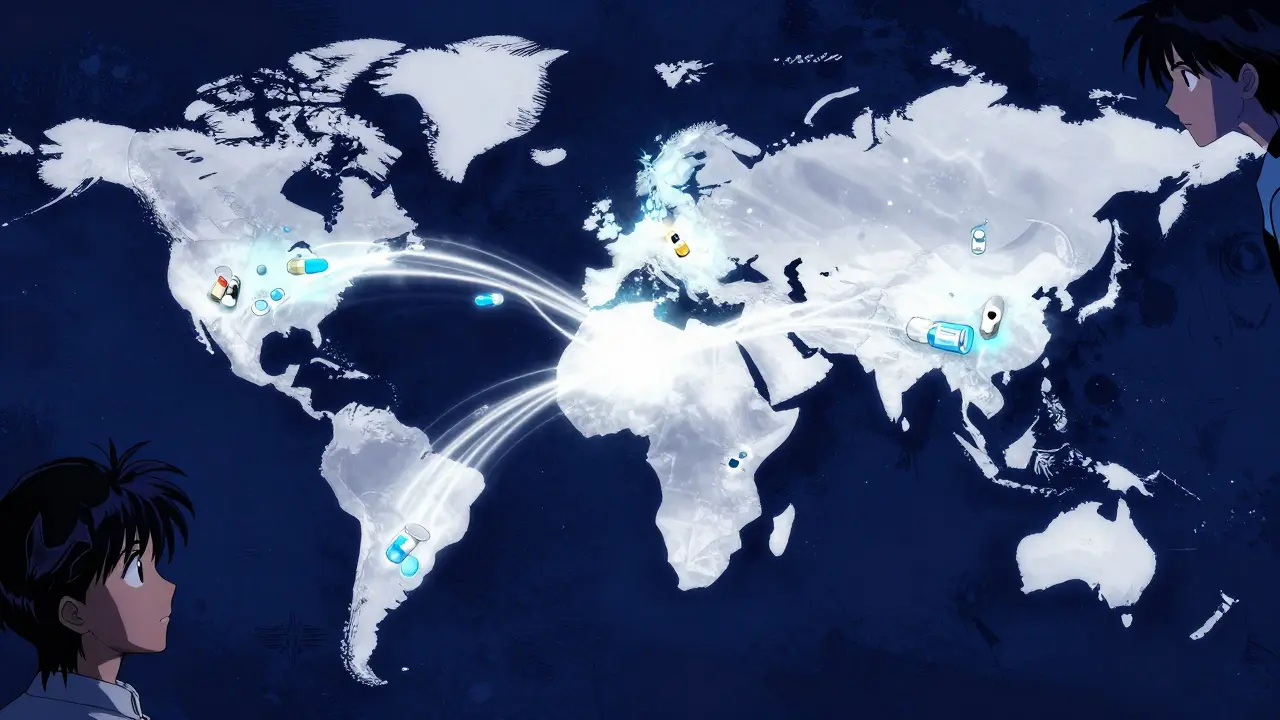
You might think Indian generics are only for developing nations, but they are deeply embedded in Western healthcare. In the United States, where generic use is incredibly high, Indian manufacturers supply roughly 40% of the generic drug demand. In the UK, they account for about 33% of the prescriptions filled by the National Health Service. When you look at Sub-Saharan Africa, the impact is even more visceral, with India providing nearly 50% of the region's pharmaceutical needs.
A great example of this is the fight against HIV/AIDS. According to reports in the Lancet, Indian generics slashed the cost of antiretroviral therapy from $10,000 to just $100 per patient annually. That shift didn't just save money; it saved millions of lives by making treatment accessible in regions where it was previously unaffordable.
| Feature | India | China | Europe (e.g., Teva/Sandoz) |
|---|---|---|---|
| US-FDA Compliant Plants | 650 (Highest outside US) | 153 | Moderate/High |
| Core Strength | High volume, low cost | API Raw Materials | Specialized therapies |
| Pricing Strategy | Aggressive cost leadership | Lowest raw material cost | Premium generics |
| Global Market Role | Finished dosage provider | Ingredient supplier | Innovation-led generics |
The Quality Puzzle and Regulatory Hurdles
When prices are this low, people naturally ask: "Is it actually safe?" For the most part, the answer is yes. Indian firms have invested heavily in compliance. They have the largest concentration of US-FDA is the United States Food and Drug Administration, the federal agency responsible for protecting public health by ensuring the safety and efficacy of drugs compliant plants outside the US. In 2015, the compliance rate for FDA inspections was around 60%; today, it's up to 85-90%, which puts them on par with global averages.
However, it's not all perfect. There are still stories of inconsistent batches or packaging issues. Some users on platforms like Reddit have mentioned issues with dissolution rates in specific medications like levothyroxine. Most of these are outliers, but they highlight the struggle of maintaining perfect quality across such a massive volume of production. For a company to even enter the US market, they often face a 3-5 year learning curve, with nearly 40% failing their initial inspections.
The Achilles' Heel: The API Problem
Here is the irony: while India is the master of the finished pill, they struggle with the ingredients inside it. These are called Active Pharmaceutical Ingredients is or APIs, the biologically active components of a drug that produce the intended health effect . India depends on China for about 70% of its API needs. This became a huge problem during the pandemic, proving that a supply chain break in one country could stop medicine production in another.
To fix this, the Indian government launched Production Linked Incentive (PLI) schemes. They've put roughly ₹3,000 crore ($400 million) on the table to encourage companies to make their own ingredients. The goal is to reach 53% API self-sufficiency by 2026. Without this, the "pharmacy of the world" remains vulnerable to geopolitical swings.

Moving Up the Value Chain: Biosimilars
For years, India's business model was "high volume, low value." They sold millions of pills but didn't make a massive profit per unit. Now, they are pivoting. The next frontier is Biosimilars is highly similar versions of biologic medicines, which are derived from living organisms and are much more complex to manufacture than chemical generics . Unlike simple chemical generics, biosimilars require intense R&D and biological precision.
Companies like Sun Pharma is one of India's largest pharmaceutical companies, focusing on specialty generics and chronic therapy and Biocon are pouring hundreds of millions into biologics. Biosimilars already make up about 8% of India's export value, up from just 3% a few years ago. This shift from simple generics to complex biologics is how India plans to move from being just a manufacturer to an innovation hub.
What This Means for the Future
With the "Pharma Vision 2047" initiative, India is aiming for $190 billion in exports by 2047. They are tightening their own rules-like the revised Schedule M guidelines implemented in early 2024-to force plants to meet higher quality standards. But the path isn't easy. Trade tensions, like the US removing certain tariff benefits in 2019, show that politics often dictate drug prices as much as chemistry does.
Whether you are a patient in New Zealand, a doctor in New York, or a health worker in Kenya, your experience with medicine is shaped by these factories. The challenge for Indian manufacturers now is to prove they can lead in innovation, not just in affordability.
Are Indian generic drugs as effective as brand-name drugs?
Yes, in the vast majority of cases. Generic drugs must contain the same active ingredient and meet the same safety and efficacy standards as the brand-name version. Field reports, such as those from Doctors Without Borders, show that Indian-sourced antimalarials and antibiotics maintain around 95% efficacy rates compared to branded versions.
Why are Indian generics so much cheaper?
The cost savings come from a few places: India does not have to pay for the initial research and development (R&D) that the original patent holder spent billions on. They also benefit from massive economies of scale, lower labor costs, and a specialized infrastructure designed for high-volume production.
What is the difference between a generic and a biosimilar?
A generic is a chemical copy of a small-molecule drug, which is relatively easy to replicate. A biosimilar is a version of a biologic drug made from living cells. Because living organisms are complex, biosimilars aren't exact copies but are "highly similar" and require much more complex manufacturing processes.
Does India really depend on China for medicine?
Yes, specifically for Active Pharmaceutical Ingredients (APIs). While India makes the final pill, they import about 70% of the raw chemical ingredients from China. The Indian government is currently using PLI schemes to reduce this dependency and increase domestic production.
How can I tell if a generic drug is FDA approved?
You can check the FDA's "Orange Book" or their database of approved generic drugs. Most reputable pharmacies only dispense generics that have passed the bioequivalence tests required by national regulatory agencies like the FDA in the US or the MHRA in the UK.
You might like