
Proton Pump Inhibitors and Antifungals: How They Interfere with Absorption and Effectiveness


Antifungal & PPI Compatibility Checker
When you’re on a proton pump inhibitor (PPI) for acid reflux and suddenly need an antifungal for a stubborn yeast infection, things get complicated fast. It’s not just about taking two pills - it’s about whether one will ruin the other. This isn’t theoretical. Real people in hospitals and clinics are getting sick because their antifungals stopped working, and the reason? A quiet, poorly understood clash between stomach acid blockers and antifungal drugs.
Why Your Antifungal Might Not Work
Some antifungals - especially itraconazole and ketoconazole - need stomach acid to dissolve properly. Without enough acid, they just sit there, undissolved, and never get absorbed into your bloodstream. That’s where PPIs come in. Drugs like omeprazole, esomeprazole, and pantoprazole shut down your stomach’s acid production. They’re great for heartburn, but they turn your stomach into a near-neutral environment. And for these antifungals, that’s a disaster.
Studies show that when you take itraconazole with a PPI, your body absorbs 60% less of the drug. That’s not a small drop. It’s enough to make the drug useless. In one study of over 1,200 patients, those on both drugs had antifungal levels so low they couldn’t kill even common Candida fungi. The result? Treatment failure. Recurring infections. Longer hospital stays.
Not All Antifungals Are Created Equal
Fluconazole is the exception. It doesn’t care about stomach acid. It dissolves easily in water, no matter how pH-neutral your stomach is. Even if you’re on the strongest PPI, fluconazole still gets into your blood at 90% efficiency. That’s why doctors often switch patients from itraconazole to fluconazole when PPIs are needed.
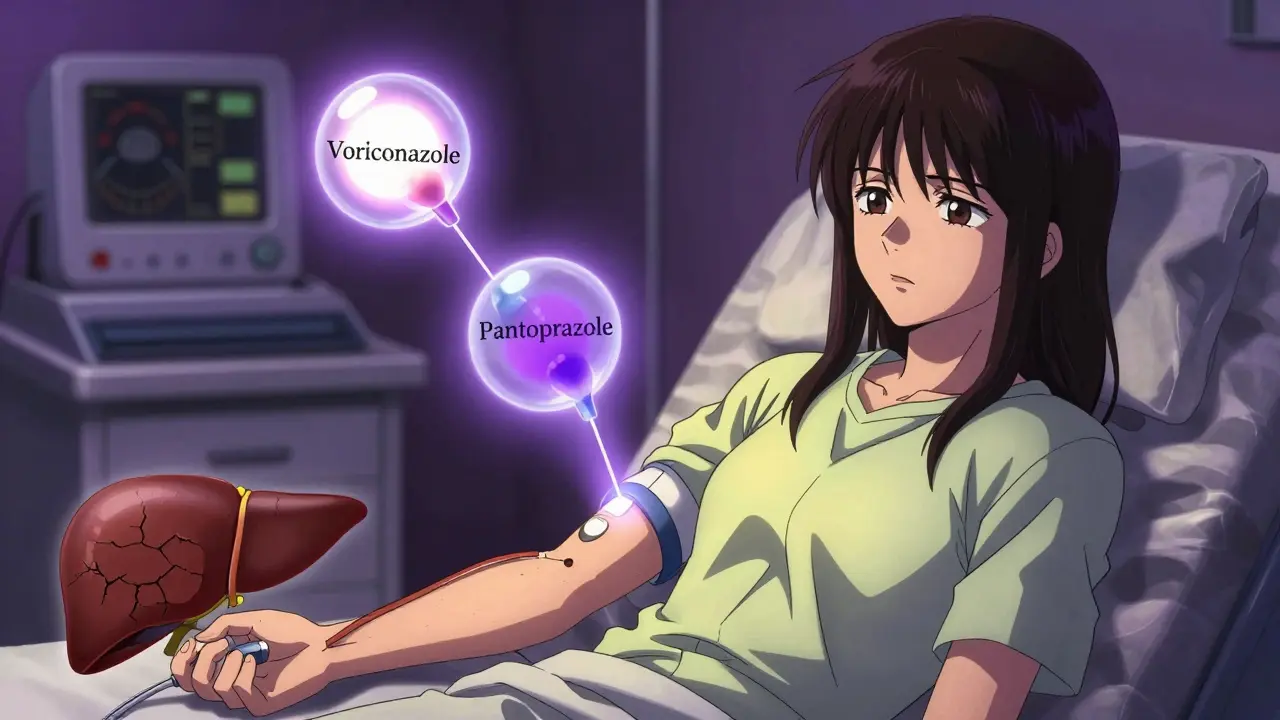
But here’s the twist: voriconazole is caught in the middle. It absorbs fine regardless of acid levels, but it’s broken down by the same liver enzyme (CYP2C19) that PPIs like pantoprazole block. So while you get the drug into your system, it sticks around longer than it should. That can push levels into the toxic range - headaches, blurry vision, even liver damage. You need blood tests to check your voriconazole levels if you’re on a PPI. No guesswork.
The Hidden Paradox: PPIs Might Actually Help Antifungals
Here’s where it gets wild. A 2024 study found something no one expected. PPIs like omeprazole don’t just block stomach acid - they also sneak into fungal cells and block a protein called Pam1p. This protein helps fungi pump out toxins and resist drugs. When you block it, the fungus becomes more vulnerable. In lab tests, omeprazole cut the amount of fluconazole needed to kill resistant Candida glabrata by 4 to 8 times.
This isn’t theory. It’s happening in petri dishes. And now, a clinical trial at Johns Hopkins is testing whether adding omeprazole to fluconazole can rescue patients with stubborn fungal infections that won’t respond to antifungals alone. If it works, we might start using acid blockers not just to calm stomachs, but to fight fungi.
What Doctors Actually Do in Real Life
In practice, most infectious disease teams avoid the whole mess. A 2023 survey of 217 pharmacists found that 87% of them recommend switching to an echinocandin - a different class of antifungal - rather than trying to time doses or monitor levels. Why? Because the risks outweigh the benefits.
But if you absolutely need itraconazole or ketoconazole, here’s what the guidelines say:
- Never take them at the same time as a PPI. Ever.
- If you must take both, give itraconazole at least 2 hours before the PPI. This helps it dissolve before acid suppression kicks in.
- For ketoconazole, separate by 4-6 hours - but even then, absorption still drops by 45%.
- Check blood levels. For itraconazole, aim for 0.5-1.0 μg/mL. Below that? You’re not getting treatment.
The FDA added a black box warning to itraconazole in 2023 - the strongest possible alert - saying PPIs are contraindicated. Yet a 2024 audit found that over 22% of prescriptions still paired them. That’s not ignorance. That’s systemic failure.

What’s Changing in 2026
There’s hope on the horizon. A new version of itraconazole - called SUBA-itraconazole - uses tiny particles that dissolve without acid. In trials, it delivered 92% of the drug regardless of whether the patient was on a PPI. The FDA is reviewing it now. If approved, it could eliminate this interaction entirely.
Meanwhile, researchers are looking at whether low-dose PPIs could be added to antifungal regimens as a booster. Imagine: a single 40mg omeprazole pill helping fluconazole crush resistant infections. It sounds like science fiction. But it’s being tested right now.
What You Need to Do
If you’re on a PPI and your doctor prescribes an antifungal:
- Ask: Which one? Fluconazole? Safe. Itraconazole? High risk.
- Ask: Do I need blood tests? Voriconazole? Yes. Itraconazole? Yes.
- Ask: Can I switch to an echinocandin? Often safer than managing this interaction.
- Don’t assume timing fixes it. Separating doses helps, but doesn’t solve the problem.
- Never stop or change your meds without talking to your doctor or pharmacist.
This isn’t about being careful. It’s about survival. Antifungal failure kills. And when a common heartburn pill turns a life-saving drug into a placebo, we can’t afford to ignore it.
Can I take fluconazole with a PPI?
Yes, fluconazole can be safely taken with proton pump inhibitors. Unlike itraconazole or ketoconazole, fluconazole doesn’t rely on stomach acid for absorption. Its bioavailability stays above 90% regardless of gastric pH. The main concern with fluconazole is its interaction with other drugs like warfarin, which may require a dose reduction of 20-30% when used together.
Why is itraconazole affected by PPIs but fluconazole isn’t?
Itraconazole is highly fat-soluble and needs an acidic environment to dissolve in the stomach so it can be absorbed. When PPIs raise stomach pH from around 2 to 5 or higher, itraconazole doesn’t dissolve properly - leading to up to a 60% drop in absorption. Fluconazole, on the other hand, is water-soluble and absorbs easily regardless of pH. It doesn’t need acid to get into your bloodstream.
What should I do if I’m on a PPI and need ketoconazole?
Avoid this combination entirely. Ketoconazole’s absorption drops drastically with PPIs, often falling below therapeutic levels. Even with separated dosing, absorption remains 45% lower than normal. The FDA and IDSA guidelines strongly advise against using ketoconazole with PPIs. Switch to fluconazole or an echinocandin instead.
Is voriconazole safe with PPIs?
Voriconazole can be used with PPIs, but it requires monitoring. PPIs inhibit the liver enzyme CYP2C19, which breaks down voriconazole. This causes voriconazole levels to rise, increasing the risk of side effects like vision changes, liver toxicity, or skin reactions. Your doctor should check your blood levels within 72 hours of starting the PPI and adjust the dose if needed.
Are there any new treatments to fix this interaction?
Yes. A new formulation of itraconazole called SUBA-itraconazole uses nanoparticles that dissolve without needing stomach acid. In clinical trials, it delivered 92% of the drug even with PPIs. The FDA is reviewing it for approval. If approved, it could replace traditional itraconazole and eliminate this interaction. In the meantime, researchers are testing whether low-dose PPIs can actually help antifungals work better by targeting fungal resistance mechanisms.
You might like



Vanessa Drummond
I was on omeprazole for years and then got a yeast infection that wouldn't quit. My pharmacist finally caught it - I was taking itraconazole like a dummy. Turned out my levels were practically zero. Switched to fluconazole and boom, gone in a week. Why isn't this common knowledge??
Nick Hamby
This is a profound example of how pharmacological simplification - the reduction of complex biological systems into binary 'drug A vs drug B' interactions - fails patients. The stomach is not merely a pH container; it is a dynamic, evolving microenvironment. To assume that acid suppression = absorption failure is reductionist. The emerging data on Pam1p inhibition suggests we are not merely observing interference - we are witnessing unintended synergy. The paradigm must shift from 'avoidance' to 'strategic modulation.'
kirti juneja
OMG I’m so glad someone finally said this!! In India, we’ve been using ketoconazole like candy for years - fungal infections, acne, you name it. Then one day my aunt ended up in the hospital because her doc didn’t know about the PPI clash. We’re lucky we had a good pharmacist who called it out. This needs to be taught in med schools across the globe, not just in the US!
Haley Gumm
So let me get this straight - we’re supposed to trust a drug that’s been flagged with a black box warning… but 22% of prescriptions still pair them? That’s not negligence. That’s institutional malpractice. Someone’s getting rich off this chaos.
Gabrielle Conroy
I’m a pharmacist 💊 and this is my daily reality. I’ve had patients cry because their antifungal ‘didn’t work’ - turns out they were on pantoprazole. I literally have a cheat sheet I print out. Fluconazole = safe ✅, voriconazole = monitor 🔬, itraconazole = avoid 🚫. And SUBA-itraconazole? I’m praying for it. This could save so many lives. 🙏
Spenser Bickett
Lmao so the 'experts' are telling us to avoid PPIs with antifungals... but then they say 'oh wait maybe PPIs help'? So which is it? Is it poison or potion?? Sounds like pharma got bored and threw a bunch of drugs at the wall to see what stuck. I’m just here for the drama.
Christopher Wiedenhaupt
I’ve been on omeprazole since 2020. My doc just prescribed fluconazole last month. I asked if it was safe - she said yes. I double-checked with my pharmacist. She said 'absolutely fine.' I feel like I just dodged a bullet. This thread is why I always ask twice. Knowledge is power.
John Smith
PPIs are overprescribed garbage anyway. People think they need them for heartburn but 80% of the time it’s just eating too much pizza. Meanwhile, we’re letting Big Pharma profit off a system that doesn’t even understand its own drugs. The real problem isn’t the interaction - it’s that doctors don’t read the damn labels.
Shalini Gautam
In India, we’ve been using fluconazole with PPIs for decades. No issues. Maybe this is a Western overcomplication. We don’t have the luxury of 5 different antifungals. We use what works. And fluconazole works. End of story.
Natanya Green
I just found out my mom was on itraconazole and omeprazole at the same time for 3 months. She had a recurrence. I’m furious. Why didn’t anyone tell us? I’ve been researching for hours. This is a medical crime. Someone needs to get fired.
Steven Pam
Honestly, this is one of those moments where medicine feels like magic. One pill makes your stomach chill, another makes your body glow… but together? They cancel each other out. Then someone says ‘wait, what if we use the chill pill to make the glow pill stronger?’ It’s wild. I’m not a scientist but I’m so here for this. Science is cool.
Timothy Haroutunian
I read the entire post. Took me 45 minutes. I’m still not sure what I’m supposed to do. Should I stop my PPI? Switch antifungals? Get blood drawn? Call my doctor? Write a letter to Congress? I just want to know if I’m going to die. The answer is buried under 12 subsections and 3 citations. If you can’t explain it in 3 sentences, you’re not helping.
Erin Pinheiro
I know this is a thing because my cousin’s ex-boyfriend’s nurse told her on TikTok. She said ‘if you’re on a PPI, never take ketoconazole unless you’re willing to risk liver failure.’ I looked it up. She was right. So now I’m scared to take anything. What if my Advil interacts with my vitamin D??